Commercial Electrical System Architecture
How a complete commercial electrical system fits together — from the medium-voltage utility service, switchgear, and service transformer through the 480Y/277V main distribution, emergency generator and transfer switch, panelboards and motor control center, down to the branch-circuit load systems, low-voltage/communication systems, building automation, and grounding. Hover, tap, or focus any component or feeder for its description and NEC reference.
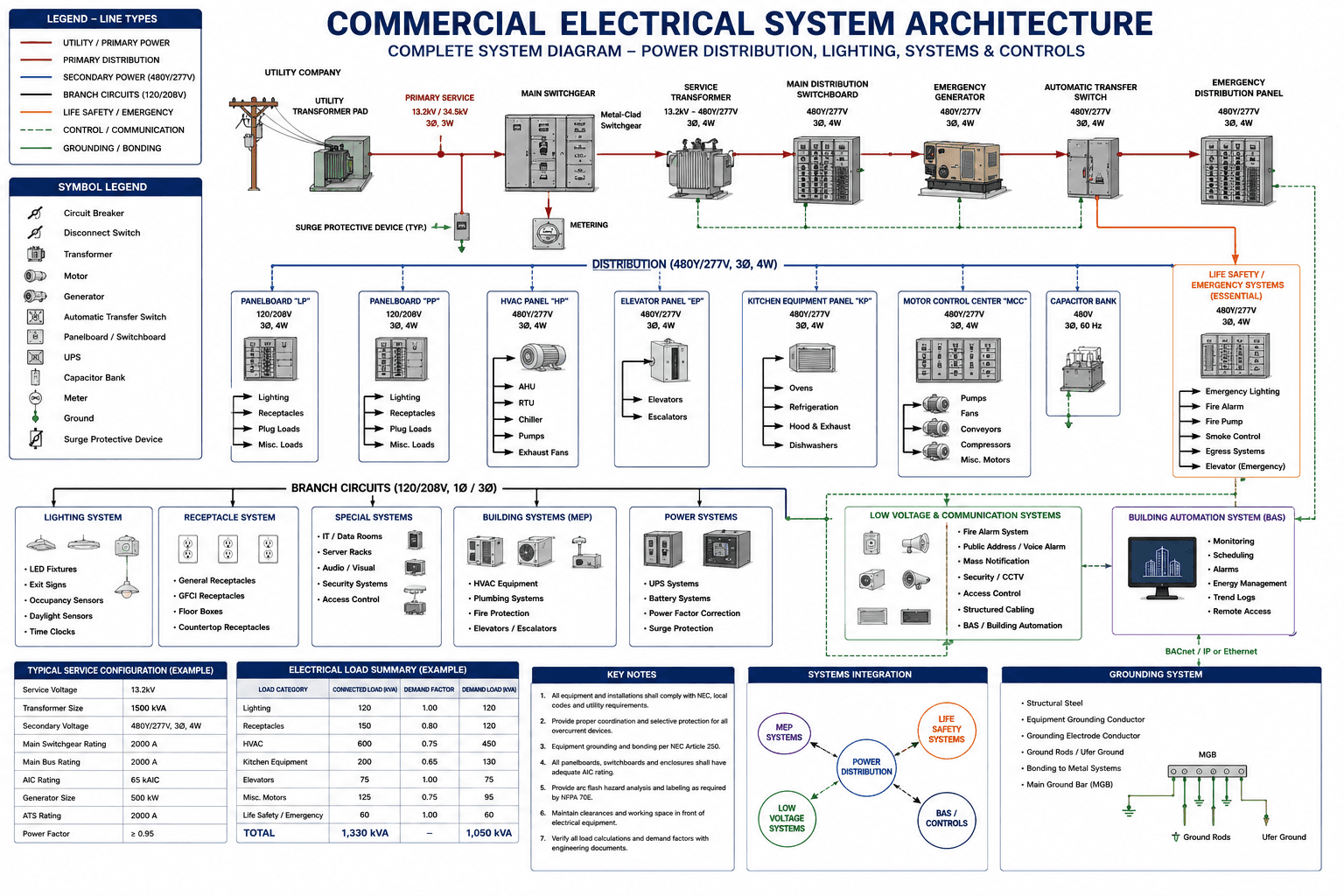
Hover, tap, or focus any component on the drawing (or a circuit below it) for details. Click to pin; move away or click again to clear.
Component Reference
Every component in the drawing above, with its function and the NEC reference that governs it.
Service & Generation
Utility Service
The incoming medium-voltage utility service (13.2 kV / 34.5 kV) is delivered to the building service point, where the utility’s responsibility ends.
📘 NEC Art. 230Utility Transformer (Pad-Mount)
A pad-mounted utility transformer provides the connection between the medium-voltage primary and the building’s service, ahead of the metering point.
📘 NEC Art. 450 / utilityMain Switchgear (Metal-Clad)
Medium-voltage metal-clad switchgear provides the main service disconnect, metering, and protective relaying at the primary voltage.
📘 NEC Art. 230 / IEEE C37Metering
Utility revenue metering — typically CT-metered at this service size — measures the building’s energy and peak demand for billing.
📘 NEC 230.66 / utilitySurge Protective Device (SPD)
A service-entrance Type 1/2 SPD limits transient overvoltages from lightning and switching, protecting downstream distribution and equipment.
📘 NEC 230.67 / Art. 242Service Transformer (Step-Down)
The service transformer steps the primary voltage down to the building secondary distribution voltage — 480Y/277V, 3-phase, 4-wire.
📘 NEC Art. 450Main Distribution Switchboard
The 480Y/277V main switchboard distributes secondary power through feeders to panelboards, step-down transformers, and the motor control center.
📘 NEC Art. 408Emergency Generator
An engine-generator provides legally-required emergency/standby power, feeding the emergency distribution through the automatic transfer switch.
📘 NEC Art. 700 / 445Automatic Transfer Switch (ATS)
The ATS monitors the normal source and automatically transfers emergency/standby loads to the generator on power loss, then retransfers when utility power returns.
📘 NEC Art. 700Emergency Distribution Switchboard
The emergency distribution switchboard distributes generator-backed power to life-safety and essential loads, kept independent of normal distribution.
📘 NEC Art. 700Distribution (Panels & MCC)
Lighting Panel “LP”
A 120/208V panelboard serving the general lighting branch circuits throughout the building.
📘 NEC Art. 408 / 410Power Panel “PP”
A 120/208V panelboard serving general-purpose receptacle and plug-load circuits.
📘 NEC Art. 408HVAC Panel “HP”
A 480/277V panelboard serving HVAC equipment — rooftop units, chillers, pumps, and exhaust fans.
📘 NEC Art. 440 / 408Elevator Panel “EP”
A 480/277V panel feeding elevator and escalator equipment, with the required shunt-trip and selective coordination.
📘 NEC Art. 620Kitchen Equipment Panel “KP”
A panel serving commercial kitchen equipment — ovens, hoods and exhaust, and dishwashers.
📘 NEC Art. 210 / 422Motor Control Center (MCC)
The MCC groups motor starters, VFDs, and overload protection for pumps, fans, and conveyors in a single coordinated assembly.
📘 NEC Art. 430 / UL 845Capacitor Bank
A capacitor bank supplies reactive power to correct system power factor, lowering demand charges and freeing distribution capacity.
📘 NEC Art. 460Essential / Emergency Panel
A panel on the emergency/essential branch serving life-safety loads such as egress lighting, exit signs, and fire pump/alarm power.
📘 NEC Art. 700Branch Circuits & Load Systems
Lighting System
Interior and exterior lighting branch circuits with occupancy and daylight controls, designed to the energy-code lighting power allowances.
📘 NEC Art. 410 / ASHRAE 90.1Receptacle System
General receptacle, plug-load, and dedicated equipment circuits, including controlled receptacles required by the energy code.
📘 NEC Art. 210Special Systems (IT / Data)
Dedicated and isolated-ground circuits plus UPS-backed power for IT/data rooms and server equipment.
📘 NEC Art. 645Building Systems (MEP)
Power to mechanical, electrical, and plumbing building equipment — HVAC, pumps, elevators, and other MEP loads.
📘 NEC Art. 440 / 430Power Systems (UPS / PFC)
Power-quality and backup systems — UPS, battery systems, power-factor correction, and surge protection for critical loads.
📘 NEC Art. 645 / 705Low Voltage, Controls & Grounding
Low Voltage & Communication Systems
Low-voltage and communication systems — fire alarm, public address / voice alarm, mass notification, security / CCTV, access control, and structured cabling.
📘 NEC Ch. 8 / Art. 760Building Automation System (BAS)
The BAS provides monitoring, scheduling, alarms, energy management, and trend logging over BACnet/IP, integrating the building’s systems.
📘 ASHRAE 135 (BACnet)Grounding System
The grounding electrode system, main grounding bus (MGB), and equipment bonding establish the low-impedance fault-clearing path and reference the system to earth.
📘 NEC Art. 250Feeders & Distribution
The power and control distribution types that wire the system together — each shown as a colored line in the diagram above.
Utility / Primary Power
The medium-voltage utility service feeding the building at primary voltage (e.g., 13.2 kV / 34.5 kV).
📘 NEC Art. 230Primary Distribution
Medium-voltage distribution between the service switchgear and the service step-down transformer(s).
📘 NEC Art. 230 / 450Secondary Power (480Y/277V)
The 480Y/277V secondary feeders from the main switchboard to panelboards, transformers, and the motor control center.
📘 NEC Art. 215Branch Circuits (120/208V)
The 120/208V branch circuits from panelboards to lighting, receptacles, and equipment.
📘 NEC Art. 210Life Safety / Emergency
Generator-backed feeders to life-safety and emergency loads, kept independent of normal distribution for survivability.
📘 NEC Art. 700–701Control / Communication
Low-voltage control and communication wiring — building automation, signaling, and data.
📘 NEC Art. 725 / Ch. 8Grounding / Bonding
Grounding electrode and equipment bonding conductors establishing the fault-clearing path and earth reference.
📘 NEC Art. 250