Radio & Wireless Communication Systems Architecture
An end-to-end view of a radio and wireless communication system — from the radio access technologies (cellular, Wi-Fi, microwave, satellite, land-mobile radio, IoT) through the RF front-end and base station (RAN), the mobile/packet core network, and the backhaul/transport, out to the applications and services. Hover, tap, or focus any component or link for its description and standard reference.
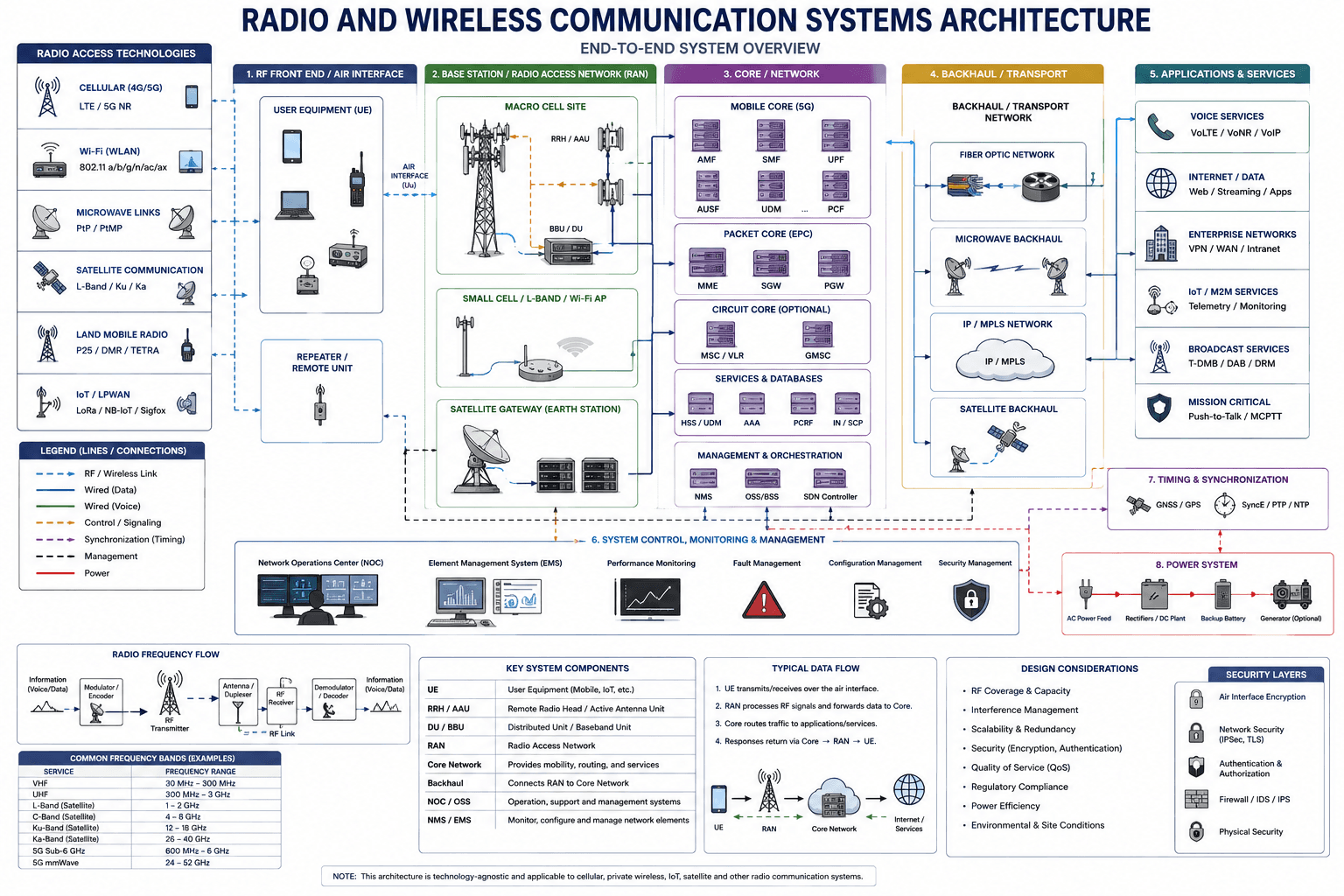
Hover, tap, or focus any component on the drawing (or a circuit below it) for details. Click to pin; move away or click again to clear.
Component Reference
Every component in the diagram above, grouped by stage of the end-to-end system, with its role and the relevant standard.
Radio Access Technologies
Cellular (4G/5G)
Licensed cellular access using LTE (4G) and 5G NR to connect mobile devices to the operator network over the air interface.
📘 3GPP LTE / 5G NRWi-Fi (WLAN)
Unlicensed wireless LAN access (802.11 a/b/g/n/ac/ax) providing local high-throughput connectivity for devices.
📘 IEEE 802.11Microwave Links
Line-of-sight microwave radio links (PtP / PtMP) used for high-capacity wireless transport between fixed sites.
📘 FCC Part 101Satellite Communication
Satellite links (L-band, Ku/Ka-band) provide wide-area and remote connectivity where terrestrial coverage is unavailable.
📘 ITU-RLand Mobile Radio
Land mobile radio for two-way voice (P25, DMR, TETRA), widely used by public safety and industrial fleets.
📘 TIA-102 (P25)IoT / LPWAN
Low-power wide-area networks (LoRaWAN, NB-IoT, Sigfox) connect battery-powered IoT sensors over long range at low data rates.
📘 3GPP NB-IoT / LoRaRF Front End & Base Station (RAN)
User Equipment (UE)
End-user devices — smartphones, handheld radios, and CPE/modems — that connect to the network over the air interface (Uu).
📘 3GPPRepeater / Remote Unit
Repeaters and remote units extend RF coverage into weak-signal or in-building areas by receiving, amplifying, and re-transmitting the signal.
📘 IFC 510Macro Cell Site
A macro cell site (tower) houses the base-station radios and antennas that provide the primary wide-area cellular coverage.
📘 3GPP RANRRH / AAU
The remote radio head or active antenna unit performs RF transmit/receive at the antenna, linked to the baseband by fiber (CPRI/eCPRI).
📘 O-RAN / CPRIBBU / DU
The baseband unit (or 5G distributed unit) performs digital signal processing and connects the radio to the core via the transport network.
📘 3GPP / O-RANSmall Cell / Wi-Fi AP
Small cells and Wi-Fi access points add localized capacity and coverage (small cell, 802.11 AP) for dense or indoor areas.
📘 3GPP / IEEE 802.11Satellite Gateway (Earth Station)
A satellite earth station/gateway links the terrestrial network to the satellite, handling the large dish antenna and RF up/down conversion.
📘 ITU-RCore Network
Mobile Core (5G)
The 5G core functions — AMF (access/mobility), SMF (session), UPF (user-plane), AUSF/UDM (auth & data), and PCF (policy) — manage connectivity, mobility, and policy.
📘 3GPP 5GCPacket Core (EPC)
The 4G/LTE Evolved Packet Core — MME (control), and SGW/PGW (user-plane gateways) — routes mobile data to external networks.
📘 3GPP EPCCircuit Core (Optional)
The legacy circuit-switched core (MSC/VLR, GMSC) handles traditional voice and SMS where still deployed.
📘 3GPP CSServices & Databases
Subscriber and service databases (HSS/HLR, UDR) store identities, subscriptions, and authentication data used across the core.
📘 3GPPBackhaul & Transport
Fiber Optic Network
Fiber optic links provide the highest-capacity, lowest-latency backhaul between cell sites and the core network.
📘 ITU-T G-seriesMicrowave Backhaul
Licensed microwave radio backhaul carries traffic from cell sites where fiber is unavailable, over line-of-sight links.
📘 FCC Part 101IP / MPLS Network
An IP/MPLS network provides the routed, traffic-engineered packet transport that aggregates backhaul toward the core.
📘 IETF MPLSSatellite Backhaul
Satellite backhaul connects remote or temporary sites to the core where terrestrial transport is impractical.
📘 ITU-RApplications & Services
Voice Services
Voice services delivered over the packet network — VoLTE, VoNR, and VoIP — replacing legacy circuit-switched voice.
📘 3GPP IMSInternet / Data
General internet and data services — web, streaming, and applications — carried over the mobile data network.
📘 IETF / 3GPPEnterprise Networks
Enterprise connectivity — VPNs, WAN, and private intranets — often delivered over dedicated APNs or 5G network slices.
📘 3GPP slicingIoT / M2M Services
Machine-to-machine and IoT application services — telemetry, remote monitoring, and control of connected devices.
📘 3GPP / oneM2MBroadcast Services
Digital broadcast services (DAB/T-DAB, DRM) deliver one-to-many audio and data over dedicated broadcast spectrum.
📘 ETSI DAB / DRMMission-Critical Services
Mission-critical communications — MCPTT push-to-talk, group calling, and priority/preemption for public safety.
📘 3GPP MCPTTLinks & Connections
The link and signal types that tie the system together — each shown as a colored line in the diagram above.
RF / Wireless Link
Over-the-air radio links between devices, antennas, and sites across licensed and unlicensed spectrum.
📘 ITU-R / 3GPPWired (Data)
Wired data transport (fiber / Ethernet / IP) carrying user-plane and control-plane traffic.
📘 IEEE 802.3Wired (Voice)
Wired voice trunks and paths between switching and gateway elements.
📘 3GPP IMSControl / Signaling
Signaling between network elements that sets up, manages, and tears down sessions (e.g., Diameter, SIP, SS7).
📘 3GPP signalingSynchronization (Timing)
Timing/synchronization distribution (GPS / PTP) that keeps radios and network elements phase- and frequency-aligned.
📘 IEEE 1588 / ITU-T G.8275Management
Network management and OAM traffic for configuration, monitoring, and service assurance.
📘 TMN / SNMPPower
AC/DC power feeds and battery/backup supplying sites and equipment.
📘 NEC / ATIS