STEM Fundamentals — FE Exam Math, Chemistry & Statistics Prep
Unlike every other studio's exam bank, which targets a discipline-specific credential, these three practice exams target the math, chemistry, and statistics content that is shared across every NCEES FE exam, regardless of discipline. If you are prepping for FE Electrical, FE Mechanical, FE Civil, or any other FE exam, the Mathematics and Probability & Statistics sections here apply to you directly.
The credential landscape
The NCEES FE exam is organized by discipline (Electrical, Mechanical, Civil, Chemical, and so on), but every discipline's exam specification includes a Mathematics section and a Probability and Statistics section drawn from the same core content — algebra, calculus, linear algebra, differential equations, descriptive statistics, and probability distributions. Several disciplines also draw on general chemistry. Rather than duplicate this content inside every discipline-specific studio, it lives here once, framed explicitly around the shared FE Reference Handbook sections. Use these three exams as a fundamentals check before or alongside your discipline-specific FE prep in whichever studio matches your field.
- 1Work through the STEM calculators to refresh derivatives, matrices, kinematics, and stoichiometry
- 2Take the FE Mathematics practice exam and review every miss
- 3Take the FE Probability & Statistics practice exam
- 4If your discipline's FE includes chemistry, take the FE Chemistry practice exam
- 5Move on to your discipline-specific FE practice exam with the fundamentals solid
FE fundamentals (all disciplines)
FE Mathematics
✓ PRACTICE EXAM READYAlgebra, calculus, linear algebra, and differential equations as tested on every NCEES FE exam.
FE Probability & Statistics
✓ PRACTICE EXAM READYDescriptive statistics, probability rules, and distributions as tested on every NCEES FE exam.
FE Chemistry
✓ PRACTICE EXAM READYAtomic structure, stoichiometry, solutions, and gas laws as tested on the FE exams that include chemistry.
FE Other Disciplines Fundamentals
✓ PRACTICE EXAM READYEthics, engineering economics, statics, dynamics, strength of materials, fluids, instrumentation, and E&M — the rest of the FE Other Disciplines outline.
Unlock Everything
One pass unlocks this and everything else: no per-item purchases, no subscription, lifetime access to everything on EngineersUniverse.
Every premium tool, simulator, reader, exam, program, and resource on the site, the Procurement Tools, and everything we add in the future. Pay once, never again.
Contact us with any questions
Requirements at a glance
| Credential | Prerequisite | Typical experience | Administered by |
|---|---|---|---|
| FE Mathematics | None | None | NCEES (shared across disciplines) |
| FE Probability & Statistics | None | None | NCEES (shared across disciplines) |
| FE Chemistry | None | None | NCEES (discipline-dependent) |
* Experience hours and prerequisites vary significantly by state, jurisdiction and credential level. Figures shown are typical ranges, not legal requirements.
Exam strategies & study tips
Use the same edition of the code/handbook the exam is written to, and the certifying body’s official references. Exams are tied to a specific cycle — the wrong edition costs you on lookup questions.
Before timing yourself on a full practice exam, use the STEM calculators to rebuild fluency: the derivative & limit evaluator, the matrix determinant/inverse tool, the quadratic solver, and the stoichiometry calculator all mirror the exact calculation types the FE Mathematics and FE Chemistry exams test.
It is a small section on any single discipline exam, but it is entirely skippable-feeling until exam day — normal distribution z-scores, expected value, and basic hypothesis testing show up reliably and are quick points if you have practiced them.
Confirm the exact education, experience hours and application steps with the certifying body or state board first — missing a prerequisite trips up more people than the exam content does.
Frequently asked questions
No — take these in addition. Every discipline studio (Electrical, Mechanical, Civil, and so on) has its own full-length FE practice exam covering that discipline's specific engineering content. These three STEM exams cover only the Mathematics, Probability & Statistics, and Chemistry sections that are shared across disciplines, so they complement rather than replace your discipline-specific practice exam.
No. Chemistry's weight varies by discipline — it is more prominent on exams like FE Chemical and appears in a smaller "Other Disciplines" bucket for some fields, and is largely absent from others (e.g., FE Electrical and Computer). Check your specific discipline's NCEES exam specification to see how much chemistry content actually applies to you.
NCEES restricts test-takers to a short list of approved on-screen calculators (Casio, HP, and Texas Instruments models specified by NCEES); no personal calculator is permitted at the test center. This studio's calculators are learning and practice tools for building fluency beforehand, not a substitute for practicing on an NCEES-approved model.
Mathematics and Probability & Statistics together are typically a modest fraction of the 110-question FE exam — usually in the range of 10-15% depending on discipline — but because they are foundational, weakness here often costs points in disguise on discipline-specific questions that require the same calculus or algebra skills to set up.
Practice with the studio's free tools
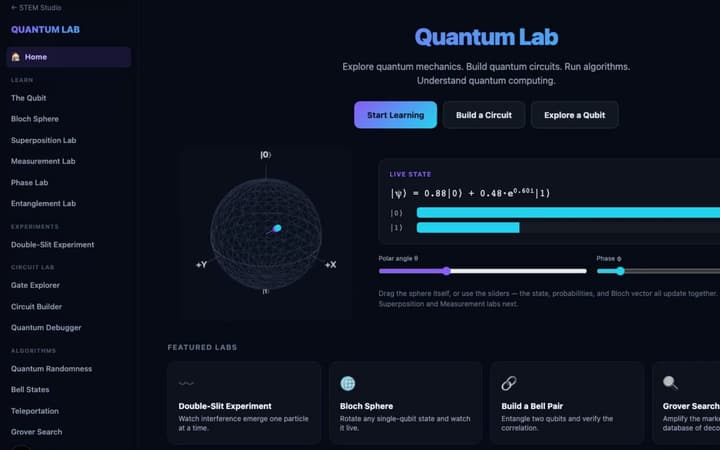
Many exam questions are calculation problems you can rehearse right now with the free tools in the STEM Learning Studio: