Residential Electrical System Architecture
How a complete residential electrical system fits together — from the utility service, meter, and main panel through the branch circuits to every outlet, light, and appliance, plus the 240 V dedicated circuits, low-voltage systems, grounding, and whole-house equipment. Hover, tap, or focus any component or conductor for its description and NEC reference.
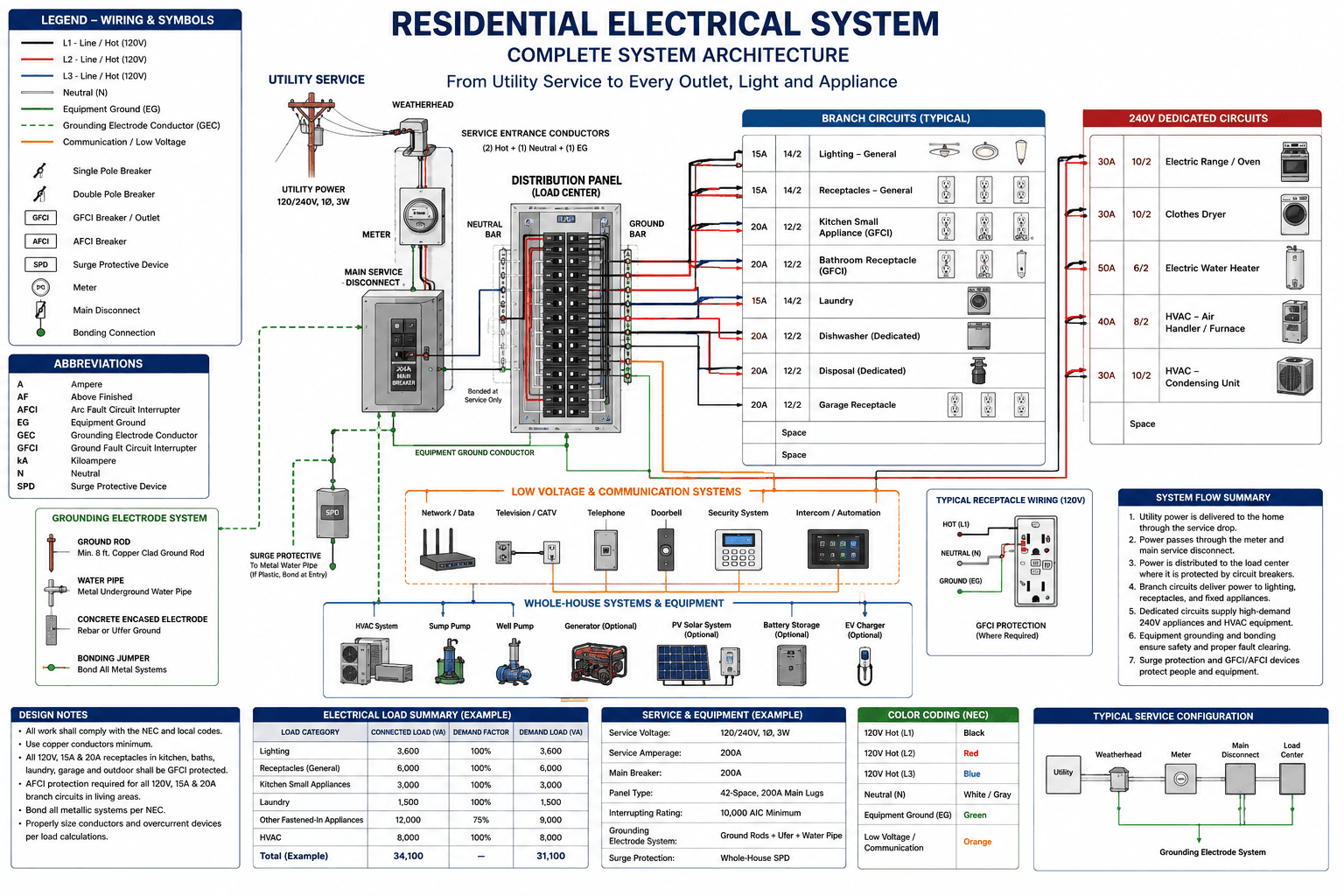
Hover, tap, or focus any component on the drawing (or a circuit below it) for details. Click to pin; move away or click again to clear.
Component Reference
Every component in the drawing above, with its function and the NEC reference that governs it.
Service & Distribution
Utility Service
The utility service drop/lateral and weatherhead deliver 120/240 V single-phase power to the home’s service point, where the utility’s responsibility ends and the premises wiring begins.
📘 NEC Art. 230Electric Meter
The utility meter measures the home’s energy use for billing, mounted ahead of (or combined with) the main service disconnect.
📘 NEC Art. 230 / utilityMain Service Disconnect
The main breaker is the service disconnecting means that shuts off all power to the home and sets the service rating (commonly 100 A or 200 A).
📘 NEC 230.70Distribution Panel (Load Center)
The load center distributes power from the service to every branch-circuit breaker. It contains the energized bus bars, a neutral bus, and an equipment-ground bus.
📘 NEC Art. 408Neutral Bus
The neutral (grounded conductor) bus collects branch-circuit neutrals; it is bonded to ground only at the service, through the main bonding jumper.
📘 NEC 200 / 250.24Ground Bus / Bar
The equipment-ground bus terminates all branch-circuit grounding conductors and bonds the panel enclosure to the grounding system.
📘 NEC 250.24 / 408.40Surge Protective Device (SPD)
A Type 1/Type 2 surge protective device at the panel limits transient overvoltages from lightning and switching, and is now required for dwelling-unit services.
📘 NEC 230.67 / Art. 242Grounding Electrode System
Ground rods, a metal water-pipe bond, and the concrete-encased (Ufer) electrode connect the system to earth through the grounding electrode conductor, establishing the ground reference.
📘 NEC 250 Pt. IIIBranch Circuits (120 V)
Lighting Circuit (15 A)
A 15 A general-lighting branch circuit on 14 AWG wire serves luminaires and switches; lighting load is estimated at 3 VA/ft² per NEC 220.12.
📘 NEC 210.70 / 220.12General Receptacles (15/20 A)
General-purpose receptacle circuits, spaced so no point along a wall is more than 6 ft from an outlet, with AFCI protection required in most living areas.
📘 NEC 210.52 / 210.12Kitchen Small-Appliance (20 A GFCI)
At least two 20 A small-appliance branch circuits serve the kitchen counter receptacles, all of which require GFCI protection.
📘 NEC 210.11 / 210.8Bathroom Receptacle (20 A GFCI)
A dedicated 20 A circuit serves the bathroom receptacle outlets, which require GFCI protection.
📘 NEC 210.11(C)(3) / 210.8Laundry Circuit (20 A)
A dedicated 20 A laundry branch circuit serves the laundry-area receptacles, kept separate from other loads.
📘 NEC 210.11(C)(2)Dishwasher (Dedicated)
A dedicated circuit for the built-in dishwasher, GFCI-protected per NEC 210.8 for dwelling-unit kitchen appliances.
📘 NEC 210.8 / Art. 422Garbage Disposal (Dedicated)
A dedicated branch circuit for the garbage disposal, typically switch-controlled at the counter.
📘 NEC Art. 422Garage Receptacle (20 A GFCI)
Garage receptacle outlets require GFCI protection and at least one dedicated 20 A circuit for the space.
📘 NEC 210.52(G) / 210.8240 V Dedicated Circuits
Electric Range / Oven
A 240 V dedicated circuit (typically 40–50 A) supplies the electric range/oven, with the demand load taken from NEC Table 220.55.
📘 NEC 210.19 / 220.55Clothes Dryer
A 30 A 240 V dedicated circuit supplies an electric clothes dryer using a 4-wire (separate neutral and ground) connection.
📘 NEC 220.54 / 250.140Electric Water Heater
A 30 A 240 V dedicated circuit serves a storage-type electric water heater, treated as a continuous load.
📘 NEC 422.13HVAC — Air Handler / Furnace
A 240 V circuit supplies the air handler or electric furnace, with its own disconnecting means at the equipment.
📘 NEC Art. 424 / 440HVAC — Condensing Unit
A 240 V circuit with a fused disconnect supplies the outdoor A/C condensing unit, sized to the nameplate minimum circuit ampacity (MCA) and max overcurrent protection (MOCP).
📘 NEC Art. 440Low Voltage & Communication
Network / Data
Structured Category cabling distributes Ethernet/data from a central panel to wall outlets throughout the home.
📘 NEC Art. 800 / TIA-570Television / CATV
Coaxial cabling distributes cable or satellite television signals to room outlets, often through a splitter/amplifier panel.
📘 NEC Art. 820Telephone
Twisted-pair telephone cabling carries legacy voice (POTS) service from the demarcation point to jacks.
📘 NEC Art. 800Doorbell
A Class 2 low-voltage transformer powers the doorbell button and chime, isolating it from line-voltage hazards.
📘 NEC Art. 725Security System
Low-voltage cabling connects the alarm panel to door/window sensors, motion detectors, and keypads.
📘 NEC Art. 725 / 760Intercom / Automation
Low-voltage cabling serves intercom stations and home-automation controllers and devices.
📘 NEC Art. 725Whole-House Systems & Equipment
HVAC System
The central HVAC equipment is served by dedicated 240 V circuits and controlled by low-voltage thermostat wiring back to the air handler.
📘 NEC Art. 440 / 424Sump Pump
A dedicated circuit serves the sump pump; a battery backup is recommended so it keeps running during outages.
📘 NEC Art. 422Well Pump
A 240 V dedicated circuit serves the well-pump motor, with motor-rated overcurrent and overload protection.
📘 NEC Art. 430Generator (Standby)
A standby generator with a transfer switch supplies backup power to selected or whole-house loads during a utility outage.
📘 NEC Art. 702 / 445PV Solar System
A rooftop PV array and inverter interconnect to the panel, commonly through a back-fed breaker that must satisfy the busbar 120% interconnection rule.
📘 NEC Art. 690 / 705Battery Storage
An energy storage system stores PV or grid energy and can back up critical loads during outages, coordinated with the PV and service.
📘 NEC Art. 706EV Charger
A 240 V Level 2 EVSE circuit (often 40–60 A) charges an electric vehicle, with load management used where the service capacity is limited.
📘 NEC Art. 625Conductors & Wiring
The conductor types that wire the system together — each shown as a colored line in the diagram above.
Hot — L1 (Black)
One of the two ungrounded “hot” service conductors, 120 V to neutral. L1 and L2 together provide 240 V for large appliances.
📘 NEC Art. 310 / 230Hot — L2 (Red)
The second ungrounded “hot” leg, 120 V to neutral and 240 V across to L1, feeding the panel’s opposite bus.
📘 NEC Art. 310 / 230Hot — L3 (Blue)
A third ungrounded conductor present on three-phase or larger services; not used on a standard single-phase residential service.
📘 NEC Art. 310Neutral (White)
The grounded conductor that carries unbalanced return current and is bonded to ground only at the service equipment.
📘 NEC 200 / 250.24Equipment Ground (Green)
The equipment grounding conductor bonds metal enclosures and provides the low-impedance fault-return path that clears ground faults.
📘 NEC 250.118 / 250.122Grounding Electrode Conductor
Connects the service neutral/ground to the grounding electrode system (ground rods, water pipe, Ufer), referencing the system to earth.
📘 NEC 250.64 / 250.66Communication / Low Voltage
Low-voltage Class 2/3 signal and data cabling — network, TV, phone, doorbell, security — run separately from the power wiring.
📘 NEC Ch. 8 (725/800)