Mechanical Engineering Systems Architecture
An integrated, end-to-end view of mechanical systems in modern engineering — design, analyze, build, operate, maintain. From the energy sources and environment through HVAC, piping & fluid, thermal/heat-transfer, compressed-air, power-generation, vacuum, material-handling, rotating-equipment, fire-protection, and building-services systems — all tied together by the control, monitoring & automation layer. Hover, tap, or focus any component or connection for its description and standard reference.
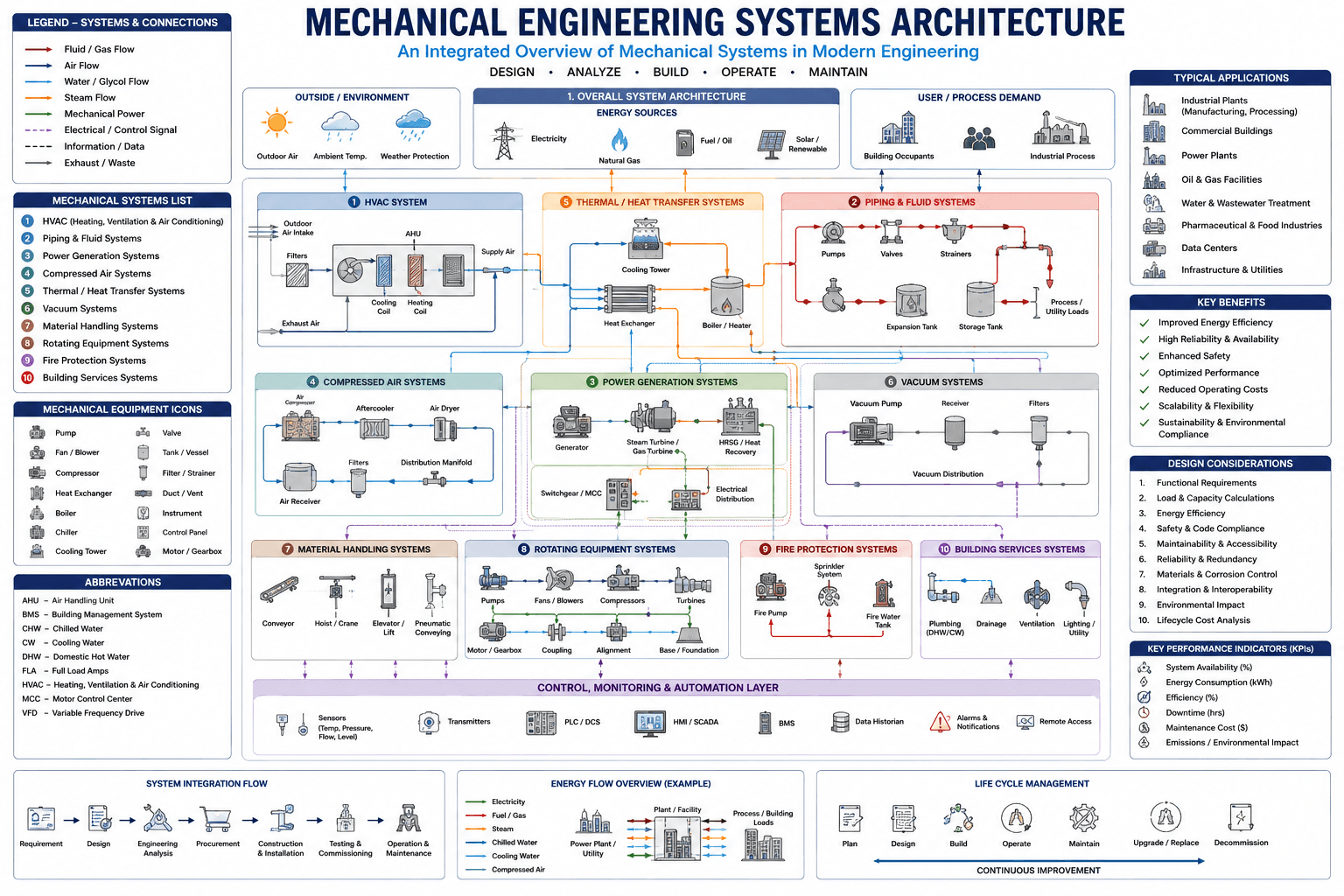
Hover, tap, or focus any component on the drawing (or a circuit below it) for details. Click to pin; move away or click again to clear.
Component Reference
Every component in the diagram above, grouped by mechanical system, with its role and the relevant engineering standard.
Energy Sources
Electricity
Electrical power from the grid or on-site generation drives motors, compressors, pumps, and controls across every mechanical system. The dominant energy input, it sets the baseline for efficiency and operating-cost analysis.
📘 NFPA 70 (NEC)Natural Gas
Natural gas fuels boilers, heaters, and gas turbines for process heat and power generation. A primary energy source for thermal systems where combustion efficiency and emissions are key design metrics.
📘 NFPA 54 (Fuel Gas)Fuel / Oil
Stored liquid fuel (diesel/fuel oil) for boilers, fired heaters, and standby/emergency generation. Common as a backup energy source where supply reliability is critical to continuity of operations.
📘 NFPA 30 (Flammable Liquids)Solar / Renewable
Solar and other renewable inputs supplement conventional energy — solar thermal for hot water/process heat or PV for electrical loads. Increasingly a first-class design driver for sustainability and energy-cost reduction.
📘 ASHRAE 90.1 / ISO 50001Outside / Environment
Outdoor Air
Outdoor air is the source for ventilation, combustion, and cooling (economizers, cooling towers). Its temperature and humidity set the design conditions for HVAC and heat-rejection equipment.
📘 ASHRAE 62.1 (Ventilation)Ambient Temperature
Ambient temperature and humidity define the heating/cooling loads and equipment capacity. Design relies on ASHRAE climatic design conditions to size systems for peak and part-load performance.
📘 ASHRAE Climatic Design DataWeather Protection
Weatherproofing of outdoor equipment — enclosures, louvers, and corrosion protection against rain, wind, and solar load. Protects reliability and service life of rooftop and outdoor mechanical equipment.
📘 NEMA 250 (Enclosures)User / Process Demand
Building Occupants
Occupants drive the comfort load — heating, cooling, ventilation, and domestic hot water demand. Occupancy density and schedules govern ventilation rates and internal heat gains in load calculations.
📘 ASHRAE 55 (Thermal Comfort)Industrial Process
Industrial processes impose the utility demand — process heat, cooling, compressed air, steam, and vacuum. These loads, often continuous and large, drive the sizing of central plant and distribution systems.
📘 Process load calculations1. HVAC System
Outdoor Air Intake
The outdoor-air intake brings fresh ventilation air into the air-handling unit, with louvers and dampers controlling the minimum and economizer airflow. Sized to meet code ventilation rates for occupants.
📘 ASHRAE 62.1Filters
Air filters remove particulate from the supply air to protect coils and maintain indoor air quality, rated by MERV (or HEPA for critical spaces). Pressure drop across filters is a key fan-energy consideration.
📘 ASHRAE 52.2 (MERV)Cooling Coil
The cooling coil (chilled water or DX) removes sensible and latent heat from the air stream, providing cooling and dehumidification. Coil capacity and approach temperature set the supply-air condition.
📘 AHRI 410 (Coils)Heating Coil
The heating coil adds heat to the air using hot water, steam, or electric resistance for space heating and reheat. Works with the cooling coil to deliver air at the required supply temperature year-round.
📘 AHRI 410 / ASHRAESupply Air
Conditioned supply air delivered through ductwork and diffusers to the occupied spaces. Airflow and temperature are modulated (CV or VAV) to meet the space heating/cooling and ventilation demand.
📘 ASHRAE 90.1 (VAV)Exhaust Air
Exhaust air removes stale air, odors, and heat from the building, often through energy-recovery devices that reclaim heating/cooling from the exhaust stream. Balanced against supply air for proper building pressurization.
📘 ASHRAE 62.1 / 90.15. Thermal / Heat Transfer Systems
Cooling Tower
The cooling tower rejects condenser heat to the atmosphere by evaporative cooling, supplying cool water back to chillers and process heat exchangers. Its approach to wet-bulb governs system efficiency.
📘 CTI ATC-105Heat Exchanger
A heat exchanger transfers heat between two fluids without mixing them — plate or shell-and-tube — for heat recovery, isolation, or process heating/cooling. Sized by LMTD, effectiveness, and fouling allowance.
📘 TEMA / ASME BPVCBoiler / Heater
Boilers and fired heaters generate hot water or steam for space heating, domestic hot water, and process loads. Combustion efficiency, turndown, and emissions are central to thermal-system design and operating cost.
📘 ASME BPVC Section IV2. Piping & Fluid Systems
Pumps
Pumps move liquids and provide the pressure to overcome system head — chilled/hot water, condenser water, and process fluids. Selected to operate near best-efficiency point on the system curve.
📘 HI / ANSI Pump StandardsValves
Valves isolate, throttle, and control flow direction and rate throughout the piping network — gate, globe, ball, check, and control valves. Control-valve Cv and authority govern stable modulation.
📘 ANSI/ISA-75 (Control Valves)Strainers
Strainers capture pipe debris and particulate to protect pumps, valves, and coils downstream. Y-type and basket strainers are placed ahead of sensitive equipment, with differential pressure indicating when to clean.
📘 ASME B31.1 / B31.3Expansion Tank
The expansion tank absorbs the volume change of water as it heats and cools, maintaining system pressure within limits and preventing relief-valve discharge. Sized from system volume and temperature range.
📘 ASME BPVC / ASHRAEStorage Tank
Storage tanks buffer fluid volume — thermal storage, condensate, or process fluids — decoupling supply from demand and adding system capacity. Used to shave peak loads and stabilize operation.
📘 API 650 / ASMEProcess / Utility Loads
The end-use loads served by the piping network — process heat exchangers, coils, and utility equipment that consume the conveyed fluids. These loads define the flow and head the distribution system must deliver.
📘 ASHRAE Systems & Equipment4. Compressed Air Systems
Air Compressor
The air compressor raises atmospheric air to working pressure for pneumatic tools, actuators, and process use. Often the largest electrical load in a plant — efficiency and control (load/unload, VFD) drive energy cost.
📘 ISO 1217 (performance)Aftercooler
The aftercooler removes the heat of compression immediately downstream of the compressor, condensing much of the moisture before the air enters the dryer and receiver. Improves dryer performance and air quality.
📘 ISO 8573 (Air Quality)Air Dryer
The air dryer (refrigerated or desiccant) lowers the compressed-air dew point to prevent condensation, corrosion, and freezing in the distribution system. Dew-point target is set by the application and ambient.
📘 ISO 8573-1Air Receiver
The air receiver stores compressed air to meet peak demand, dampen pulsations, and stabilize system pressure, reducing compressor cycling. Sized from demand variability and acceptable pressure swing.
📘 ASME BPVC Section VIIIFilters (Air)
Coalescing and particulate filters remove oil aerosols, water, and solids to deliver air at the required ISO 8573 quality class. Pressure drop and element life are balanced against air-quality requirements.
📘 ISO 8573-1 (classes)Distribution Manifold
The distribution manifold and header pipe the treated compressed air to points of use, sized to limit pressure drop and looped for balanced supply. Leak management here is the biggest energy-savings opportunity.
📘 Pressure-drop design3. Power Generation Systems
Generator
The generator converts mechanical shaft power from an engine or turbine into electrical power for on-site use or standby. Central to prime-power, cogeneration, and emergency-backup configurations.
📘 NFPA 110 (Emergency Power)Steam Turbine / Gas Turbine
Steam and gas turbines are the prime movers driving generators and large equipment, expanding high-energy steam or combustion gas to extract shaft work. The heart of power and combined-heat-and-power plants.
📘 ASME PTC 6 / PTC 22HRSG / Heat Recovery
The heat-recovery steam generator captures exhaust heat from a gas turbine or engine to raise steam, dramatically improving overall plant efficiency in combined-cycle and cogeneration systems.
📘 ASME BPVC / PTC 4.4Switchgear / MCC
Switchgear and motor control centers distribute and protect electrical power to mechanical equipment, housing breakers, starters, and VFDs. The interface between the electrical supply and rotating loads.
📘 NEMA / IEEE C37 / NEC 430Electrical Distribution
The electrical distribution system routes power from generation/switchgear through feeders and panels to motors, drives, and controls. Coordinated protection and conductor sizing follow the NEC.
📘 NFPA 70 (NEC)6. Vacuum Systems
Vacuum Pump
The vacuum pump removes air/gas to create the sub-atmospheric pressure used for medical, laboratory, and process applications. Selected by required vacuum level and flow, with liquid-ring, rotary-vane, or claw types.
📘 ISO 21360 (Vacuum)Receiver (Vacuum)
The vacuum receiver stores evacuated volume to meet peak demand and stabilize system vacuum, reducing pump cycling. Acts as the buffer between the vacuum pump and fluctuating point-of-use demand.
📘 ASME BPVC Section VIIIFilters (Vacuum)
Inlet filters protect the vacuum pump and downstream equipment from particulate and liquids drawn in with the evacuated air. Maintain pump performance and the cleanliness required by the application.
📘 Application-specificVacuum Distribution
The vacuum distribution piping carries the system vacuum to outlets and process connections, sized to limit pressure rise (loss of vacuum) at the farthest point. Sloped and trapped to manage condensate.
📘 NFPA 99 (Medical Vacuum)7. Material Handling Systems
Conveyor
Conveyors move bulk and unit materials continuously between process stages — belt, roller, and screw types. Drive power, belt tension, and loading govern motor and gearbox selection.
📘 CEMA / ASME B20.1Hoist / Crane
Hoists and cranes lift and position heavy loads for assembly, maintenance, and material movement. Rated by capacity, span, and duty class, with mechanical and electrical safety interlocks.
📘 ASME B30 (Cranes/Hoists)Elevator / Lift
Elevators and lifts provide vertical transport of people and goods between levels — traction or hydraulic. Sized for load, speed, and traffic, with safety systems governed by the elevator safety code.
📘 ASME A17.1 (Elevators)Pneumatic Conveying
Pneumatic conveying transports powders and granular materials through pipe using an air stream (dilute or dense phase). Blower/compressor power and air velocity are sized to the material and distance.
📘 Dilute/dense-phase design8. Rotating Equipment Systems
Pumps (Rotating)
As rotating machines, pumps are designed and maintained for reliability — bearing life, seal selection, vibration, and NPSH margin. A core focus of the rotating-equipment and reliability disciplines.
📘 API 610 / HIFans / Blowers
Fans and blowers move air and gas for ventilation, combustion, cooling, and process draft. Selected from the fan curve to the system resistance; affinity laws relate speed to flow, pressure, and power.
📘 AMCA 210 (fan testing)Compressors (Rotating)
Compressors raise gas pressure for process, refrigeration, and air systems — centrifugal, reciprocating, and screw. High-energy rotating machines where surge, vibration, and efficiency are critical design concerns.
📘 API 617 / API 618Turbines (Rotating)
Turbines extract energy from steam, gas, or liquid to produce rotating shaft power. As high-speed machines they demand precise balancing, bearing design, and condition monitoring for safe, reliable operation.
📘 API 612 / ASME PTCMotor / Gearbox
Electric motors drive rotating equipment, with gearboxes converting speed and torque to match the load. Motor efficiency (IE class) and gear rating drive both performance and lifecycle energy cost.
📘 NEMA MG-1 / AGMACoupling
Couplings connect driver and driven shafts, transmitting torque while accommodating minor misalignment and damping shock. Flexible couplings reduce vibration and protect bearings and seals.
📘 AGMA 9000 (Couplings)Alignment
Precision shaft alignment between coupled machines minimizes vibration, bearing and seal wear, and energy loss. Laser alignment to tight tolerances is a cornerstone of rotating-equipment reliability.
📘 ANSI/ASA S2.75Base / Foundation
The base and foundation rigidly support rotating equipment and control vibration, providing mass and stiffness to keep natural frequencies away from operating speed. Grouting and anchoring preserve alignment.
📘 ACI 351 (Machine Foundations)9. Fire Protection Systems
Fire Pump
The fire pump boosts water pressure and flow to the sprinkler and standpipe systems when the supply alone is inadequate. Sized to the hydraulically most-demanding area and tested per NFPA 25.
📘 NFPA 20 (Fire Pumps)Sprinkler System
The automatic sprinkler system distributes water through a network of pipes and heads to control or suppress fire. Designed hydraulically to deliver the required density over the design area.
📘 NFPA 13 (Sprinklers)Fire Water Tank
The fire water tank stores a dedicated supply to feed the fire pump and sprinkler system for the required duration when municipal supply is insufficient or unreliable. Capacity set by demand and duration.
📘 NFPA 22 (Water Tanks)10. Building Services Systems
Plumbing (DHW / CW)
The plumbing system distributes domestic cold and hot water to fixtures and equipment, sized by fixture-unit demand and pressure. Includes heaters, recirculation, and backflow protection.
📘 IPC / UPCDrainage
The drainage system carries sanitary and storm flow away by gravity, with vents to protect trap seals. Pipe sizing and slope follow drainage-fixture-unit methods in the plumbing code.
📘 IPC (DFU sizing)Ventilation
Building ventilation supplies outdoor air and exhausts stale air to maintain indoor air quality and control contaminants, humidity, and odors. Rates are set by occupancy and use per the ventilation standard.
📘 ASHRAE 62.1Lighting / Utility
Lighting and general building utilities support the occupied environment and equipment operation. Managed for energy efficiency and code compliance alongside the mechanical systems.
📘 ASHRAE 90.1 / IECCControl, Monitoring & Automation Layer
Sensors (Temp, Pressure, Flow, Level)
Sensors measure temperature, pressure, flow, and level across the mechanical systems, providing the data the control system acts on. Accuracy and placement set the quality of control and energy optimization.
📘 ISA-5.1 / ASHRAE Guideline 36Transmitters
Transmitters condition and scale sensor signals into standard 4–20 mA or digital outputs for the controllers. Smart transmitters add diagnostics and remote ranging over the control network.
📘 ANSI/ISA-50 / HARTPLC / DCS
Programmable logic controllers and distributed control systems execute the control logic that sequences and modulates mechanical equipment. The automation core linking sensors to final control elements.
📘 IEC 61131-3HMI / SCADA
HMI and SCADA give operators the window into the systems — graphics, alarms, trends, and supervisory control. The day-to-day interface for running and troubleshooting the mechanical plant.
📘 ISA-101 (HMI Design)BMS (Building Management System)
The building management system integrates HVAC, plumbing, lighting, and energy controls onto one platform (often BACnet), optimizing comfort and energy use. The brain coordinating building mechanical services.
📘 ASHRAE 135 (BACnet)Data Historian
The data historian records time-series process data at high resolution for trending, analytics, and fault diagnosis. The foundation for performance monitoring, commissioning, and continuous optimization.
📘 Time-series databaseAlarms & Notifications
The alarm and notification layer flags abnormal conditions — out-of-range values, equipment faults, and safety trips — and routes them to operators. Rationalized alarms cut noise so real problems surface fast.
📘 ISA-18.2 (Alarm Mgmt)Remote Access
Secure remote access lets engineers monitor and adjust the systems off-site for diagnostics and optimization. Gated by network security controls to protect the operational technology environment.
📘 IEC 62443 (OT Security)Reference Panels
Typical Applications
Where this mechanical architecture applies — industrial plants, commercial buildings, power plants, oil & gas, water/wastewater, pharma & food, data centers, and infrastructure/utilities. The systems stay the same; the equipment and codes change by sector.
📘 Cross-sectorKey Benefits
The architecture’s headline goals: improved energy efficiency, high reliability and availability, enhanced safety, optimized performance, reduced operating cost, scalability and flexibility, and sustainability/environmental compliance.
📘 Design objectivesDesign Considerations
The factors that drive mechanical design: functional requirements, load & capacity calculations, energy efficiency, safety & code compliance, maintainability & accessibility, reliability & redundancy, materials & corrosion control, integration & interoperability, environmental impact, and lifecycle cost.
📘 Design methodologyKey Performance Indicators (KPIs)
The KPIs used to measure mechanical-system performance: system availability (%), energy consumption (kWh), efficiency (%), downtime (hrs), maintenance cost ($), and emissions / environmental impact.
📘 Performance metricsConnections & Flows
The flow and signal types that tie the systems together — each shown as a colored line in the diagram above.
Fluid / Gas Flow
Movement of process fluids and gases through piping — the conveyed medium that pumps, compressors, and valves act on across the piping, fluid, and process systems.
📘 ASME B31 (Piping)Air Flow
Ventilation and process air movement — supply, return, and combustion air handled by fans, AHUs, and ductwork throughout the HVAC and compressed-air systems.
📘 ASHRAE / SMACNAWater / Glycol Flow
Chilled water, hot water, condenser water, and glycol loops that transport heating and cooling energy between the central plant and the loads.
📘 ASHRAE SystemsSteam Flow
Steam distribution from boilers and HRSGs to heat exchangers, turbines, and process loads, with condensate return — a primary heat- and power-transfer medium.
📘 ASME BPVC / B31.1Mechanical Power
Rotating shaft power transmitted from prime movers (motors, turbines) through couplings and gearboxes to driven equipment such as pumps, fans, and compressors.
📘 Shaft power / torqueElectrical / Control Signal
Electrical power feeds and control signals between switchgear/MCC, controllers, and field devices that energize and command the mechanical equipment.
📘 NEC / IEC 61131Information / Data
Monitoring and data flow between sensors, controllers, historians, and the BMS/SCADA layer — the information backbone for control, trending, and optimization.
📘 ASHRAE 135 (BACnet)Exhaust / Waste
Exhaust gas, waste heat, and effluent streams leaving the systems — flue gas, building exhaust, and blowdown — managed for efficiency and environmental compliance.
📘 EPA / ASHRAE 62.1