PLC Programming Poster: Scan Cycle, I/O Devices, Languages, Ladder Basics
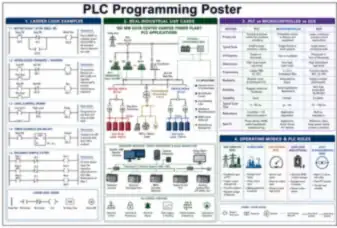
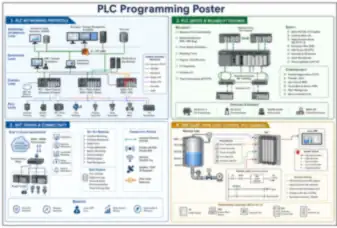
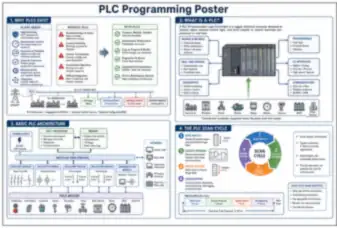
Four panels: the PLC scan cycle, typical input and output devices, the IEC 61131-3 programming languages, and ladder logic basics with contacts, coils and good practices, plus a power plant context.
Read the free drawing guide ↓How to read this drawing
A PLC program connects input information to logical decisions and output commands. The poster brings the scan cycle, field devices and programming languages into one view. Understanding the relationship between the physical signal and the program state is more useful than memorizing the appearance of a ladder symbol.
Follow the relationships
- Begin with the simplified scan model: acquire inputs, execute logic and update outputs. Actual controllers can use multiple tasks, interrupts and asynchronous I/O updates, so the exact timing depends on the platform and configuration.
- Separate a field device from its software representation. A ladder contact tests a Boolean condition; it is not automatically a physical switch contact. Trace the signal name and intended true/false meaning before interpreting the rung.
- Read each rung as a condition leading to an action. Follow dependencies such as permissives and feedback, then compare how the same intent could be expressed in another supported language. Commanding an output does not prove that a physical actuator moved.
A simulated feedback exercise
In a training model, a run command and permissive can produce an output command, while a separate feedback input represents the simulated device state. Remove feedback and observe whether the model detects the discrepancy. This teaches the distinction between a request and confirmation; it is not a circuit for controlling real machinery.
Use and limitations: An ordinary PLC logic example does not establish a safety function. Real equipment requires appropriate engineering, safety-rated systems where needed and platform-specific documentation. Use the browser lab for these experiments.
Public reading guide updated . The full-size drawing requires All-Access.