AI Engineering System Architecture
The full 8-step end-to-end AI system lifecycle (problem definition & planning, data collection & ingestion, data preparation & labeling, model development & training, evaluation & validation, deployment & serving, monitoring & operations, and retrain & continuous improvement), the seven core AI engineering disciplines that make up the system (data engineering, modeling & training, evaluation & governance, deployment & MLOps, observability & monitoring, infrastructure & platforms, and application & integration), and a typical reference architecture and RAG/generative AI pipeline example showing how data, models, and applications connect in production. Hover, tap, or focus any component for its description and standard reference.
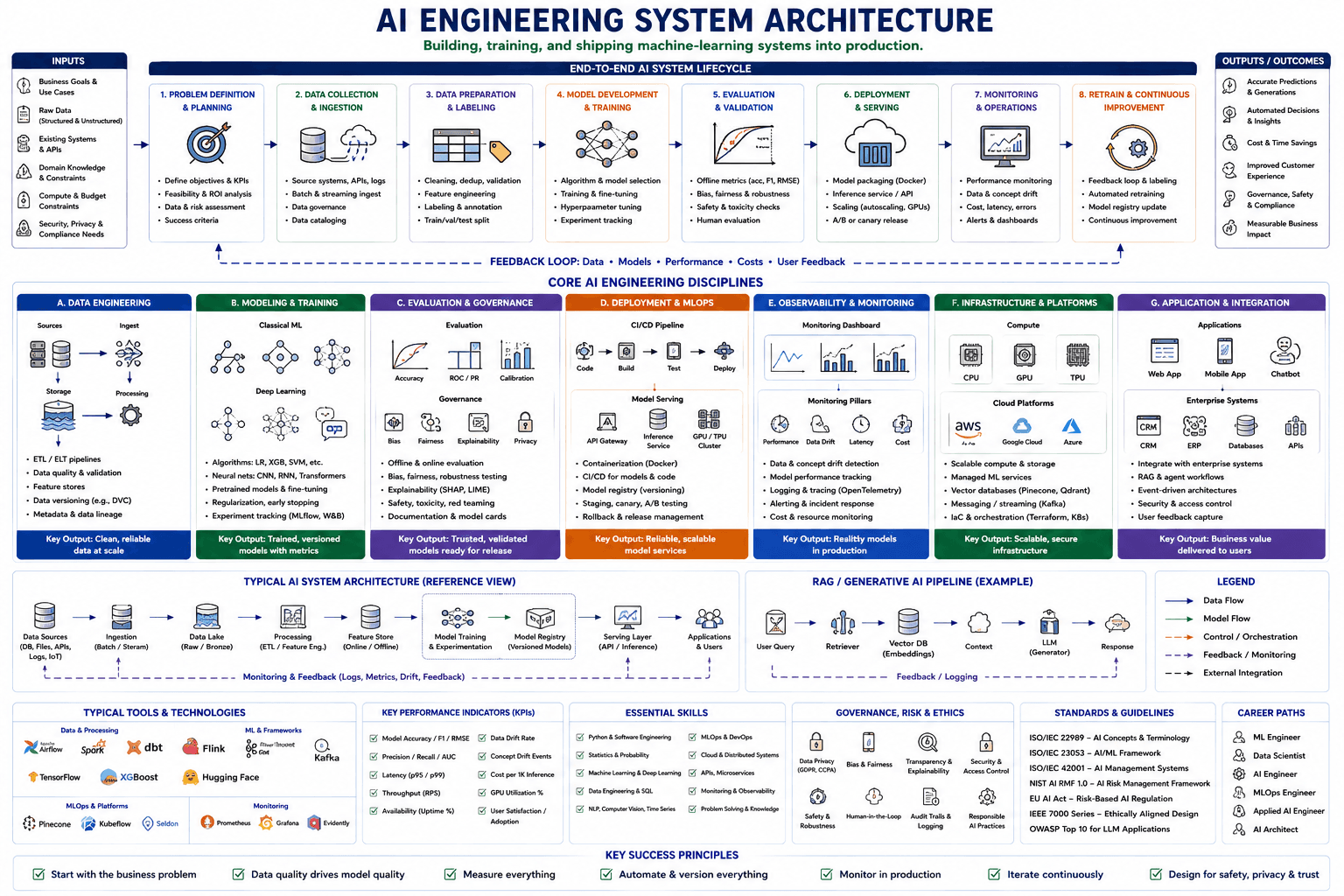
Hover, tap, or focus any component on the drawing (or a circuit below it) for details. Click to pin; move away or click again to clear.
Component Reference
Every component in the diagram above, grouped by section, with its role and the relevant standard.
Inputs
Business Goals & Use Cases
The starting requirement for any AI system — the specific business goal or use case the project is meant to serve. Every downstream decision, from data collection to model choice, is judged against whether it moves this goal forward.
Raw Data (Structured & Unstructured)
The structured (databases, tables) and unstructured (text, images, documents, sensor logs) data available to train and evaluate the system. Its volume, quality, and coverage set a hard ceiling on what the model can eventually learn.
Existing Systems & APIs
The enterprise systems, databases, and APIs the AI solution must read from or write into — CRMs, ERPs, data warehouses, and internal services. These constrain the integration architecture from day one.
Domain Knowledge & Constraints
The subject-matter expertise, business rules, and regulatory constraints that domain experts bring — often the difference between a model that is statistically accurate and one that is actually usable in the real workflow.
Compute & Budget Constraints
The compute (GPU/TPU) and financial budget available for training and serving. These constraints drive early architecture trade-offs — training from scratch vs. fine-tuning, self-hosting vs. API, model size vs. latency.
Security, Privacy & Compliance Needs
Data-handling, privacy, and regulatory requirements (GDPR, CCPA, industry-specific rules) that shape what data can be used, how it must be stored, and what governance controls the finished system needs before it can ship.
Outputs & Outcomes
Accurate Predictions & Generations
The model's core deliverable — predictions, classifications, or generated content accurate and reliable enough for the business to act on. Everything upstream (data, training, evaluation) exists to make this outcome trustworthy.
Automated Decisions & Insights
Decisions or analytical insight the system produces automatically at a scale humans could not match manually — the practical payoff of turning a trained model into a running production service.
Cost & Time Savings
Measurable efficiency gains from automating work that previously required manual effort — one of the clearest, most defensible ROI arguments for an AI investment.
Improved Customer Experience
Faster response times, more personalized service, and higher availability for end users — the customer-facing outcome that AI-powered features (chat, recommendations, search) are usually built to deliver.
Governance, Safety & Compliance
A system that meets its governance, safety, and regulatory bar in production — not just accurate, but auditable, fair, and safe enough to operate without unacceptable risk.
Measurable Business Impact
The final scoreboard — revenue, retention, throughput, or risk-reduction numbers that tie the AI investment back to the original business goal and justify the next round of iteration or investment.
AI System Lifecycle
1. Problem Definition & Planning
Defines the objectives and KPIs the project will be judged on, runs a feasibility and ROI analysis, assesses data and delivery risk, and sets success criteria — the step that decides whether an AI approach is even the right tool before any data work begins.
2. Data Collection & Ingestion
Identifies source systems, APIs, and logs; builds batch and streaming ingestion pipelines; and applies data governance and cataloging so the raw material for training is discoverable, traceable, and compliant.
3. Data Preparation & Labeling
Cleans, deduplicates, and validates the raw data; engineers features; labels and annotates examples; and carves out train/validation/test splits — the unglamorous work that most directly determines final model quality.
4. Model Development & Training
Selects the algorithm or model family, runs training and fine-tuning, tunes hyperparameters, and tracks every experiment so results are reproducible — the core research-and-engineering loop of building the model itself.
5. Evaluation & Validation
Measures offline metrics (accuracy, F1, RMSE), tests for bias, fairness, and robustness, runs safety and toxicity checks, and adds human evaluation — the gate a model must pass before it is trusted with real traffic.
6. Deployment & Serving
Packages the model (typically as a Docker image), stands up an inference service or API, configures autoscaling and GPU capacity, and rolls out via A/B or canary release to limit blast radius.
7. Monitoring & Operations
Tracks live performance, watches for data and concept drift, monitors cost/latency/error rates, and wires up alerts and dashboards so operators know the moment the system starts to degrade.
8. Retrain & Continuous Improvement
Feeds production feedback and labels back into the pipeline, triggers automated retraining, updates the model registry, and closes the loop on continuous improvement — turning the lifecycle into a cycle rather than a one-time project.
Feedback Loop: Data, Models, Performance, Costs, User Feedback
The dashed feedback loop that carries data quality signals, model performance, cost data, and user feedback from step 8 back to step 1 — the mechanism that makes the AI system lifecycle a genuine loop instead of a one-way pipeline.
Data Engineering
A. Data Engineering — Sources, Ingest, Storage, Processing
The data engineering pipeline that feeds every model: source systems flow into ingestion, land in storage, and pass through processing — the plumbing that has to run reliably before any model can be trained.
A. Data Engineering — Practices & Key Output
ETL/ELT pipelines, data quality and validation checks, feature stores, data versioning (e.g. DVC), and metadata/lineage tracking. Key output: clean, reliable data at scale — the foundation every other discipline in this diagram depends on.
Modeling & Training
B. Modeling & Training — Classical ML & Deep Learning
The two broad model families engineers choose from: classical machine learning (trees, linear models, SVMs) for structured, interpretable problems, and deep learning (neural networks) for high-dimensional, unstructured data.
B. Modeling & Training — Practices & Key Output
Algorithm selection (LR, XGBoost, SVM, etc.), neural nets (CNN, RNN, Transformers), pretrained models and fine-tuning, regularization and early stopping, and experiment tracking (MLflow, W&B). Key output: trained, versioned models with metrics.
Evaluation & Governance
C. Evaluation & Governance — Evaluation & Governance Metrics
Two linked concerns: model evaluation (accuracy, ROC/PR curves, calibration) that measures how well the model performs, and governance (bias, fairness, explainability, privacy) that measures whether it is safe and trustworthy to deploy.
📘 ISO/IEC 42001C. Evaluation & Governance — Practices & Key Output
Offline and online evaluation, bias/fairness/robustness testing, explainability (SHAP, LIME), safety and toxicity red-teaming, and documentation via model cards. Key output: trusted, validated models ready for release.
📘 NIST AI RMF 1.0Deployment & MLOps
D. Deployment & MLOps — CI/CD Pipeline & Model Serving
The CI/CD pipeline (code, build, test, deploy) that ships models the same disciplined way software ships, and the model-serving layer (API gateway, inference service, GPU/TPU cluster) that runs them in production.
D. Deployment & MLOps — Practices & Key Output
Containerization (Docker), CI/CD for models and code, model registry versioning, staging/canary/A-B testing, and rollback and release management. Key output: reliable, scalable model services.
Observability & Monitoring
E. Observability & Monitoring — Dashboard & Pillars
The monitoring dashboard that visualizes live behavior, built on four pillars: performance, data drift, latency, and cost — the instrumentation that tells engineers when a production model is starting to fail silently.
E. Observability & Monitoring — Practices & Key Output
Data and concept drift detection, model performance tracking, logging and tracing (OpenTelemetry), alerting and incident response, and cost/resource monitoring. Key output: reality-checked models in production.
Infrastructure & Platforms
F. Infrastructure & Platforms — Compute & Cloud Platforms
The compute layer (CPU, GPU, TPU) and the major cloud platforms (AWS, Google Cloud, Azure) that supply the raw capacity every training run and inference service ultimately runs on.
F. Infrastructure & Platforms — Practices & Key Output
Scalable compute and storage, managed ML services, vector databases (Pinecone, Qdrant), messaging/streaming (Kafka), and infrastructure-as-code orchestration (Terraform, K8s). Key output: scalable, secure infrastructure.
Application & Integration
G. Application & Integration — Applications & Enterprise Systems
How the trained model actually reaches users: web apps, mobile apps, and chatbots on one side, integrated with enterprise systems — CRM, ERP, databases, and internal APIs — on the other.
G. Application & Integration — Practices & Key Output
Integration with enterprise systems, RAG and agent workflows, event-driven architectures, security and access control, and user feedback capture. Key output: business value delivered to users.
Typical AI System Architecture (Reference View)
Data Sources (DB, Files, APIs, Logs, IoT)
The origin points of production data — databases, flat files, third-party APIs, application logs, and IoT/sensor streams — that feed the reference architecture's ingestion stage.
Ingestion (Batch / Stream)
The ingestion layer that pulls data in on a batch schedule or as a continuous stream, normalizing arrival patterns before the data lands in storage.
Data Lake (Raw / Bronze)
The raw ("bronze") landing zone where ingested data is stored in its original form before any cleaning or transformation — the durable, replayable source of truth for everything downstream.
Processing (ETL / Feature Eng.)
The transformation stage — ETL jobs and feature engineering — that turns raw bronze data into clean, model-ready features.
Feature Store (Online / Offline)
A shared, versioned repository of engineered features, split into an offline store for training and an online store for low-latency serving — keeps training and inference features consistent.
Model Training & Experimentation
The training and experimentation environment where models are built, tuned, and compared against each other before the best candidate is promoted forward.
Model Registry (Versioned Models)
A versioned catalog of trained models with lineage and metadata, giving deployment a single, auditable source for "which model is production-ready."
Serving Layer (API / Inference)
The API/inference layer that exposes the registered model to applications and users, handling request routing, batching, and scaling.
Applications & Users
The applications and end users that consume the model's predictions through the serving layer — the point where all the upstream engineering finally becomes a product.
Monitoring & Feedback (Logs, Metrics, Drift, Feedback)
The dashed feedback path that carries logs, metrics, drift signals, and user feedback from serving back to data sources, ingestion, and training — closing the loop on the reference architecture.
RAG / Generative AI Pipeline
User Query
The natural-language question or prompt submitted by a user — the trigger for the whole retrieval-augmented-generation pipeline.
Retriever
The retrieval component that searches the vector database for the passages most semantically relevant to the user's query, using embedding similarity rather than keyword matching.
Vector DB (Embeddings)
A vector database storing document embeddings, enabling fast approximate-nearest-neighbor search so the retriever can find semantically similar content at scale.
Context
The retrieved passages assembled into a context block, which gets inserted into the prompt alongside the original query so the LLM can ground its answer in real source material.
LLM (Generator)
The large language model that generates the final response, conditioned on both the user's query and the retrieved context — RAG's core trick for reducing hallucination versus an ungrounded LLM.
Response
The generated answer returned to the user, ideally grounded in the retrieved context and traceable back to its source documents.
Feedback / Logging
The dashed feedback path that logs queries, retrieved context, and responses back to the pipeline — the raw material for evaluating retrieval quality and catching hallucinations over time.
Tools & Technologies
Apache Airflow
A widely used workflow orchestrator for scheduling and monitoring data pipeline DAGs — the backbone of many production data-engineering workflows feeding AI systems.
Apache Spark
A distributed processing engine for large-scale batch and streaming data transformation — commonly used to prepare and feature-engineer datasets too large for a single machine.
dbt
A SQL-based transformation tool that lets data teams build, test, and document data models with software-engineering discipline — version control, testing, and documentation included.
Apache Flink
A stream-processing framework for real-time, low-latency data pipelines — used where features or predictions need to react to events as they happen, not on a batch schedule.
PyTorch
The dominant deep-learning framework for research and production model development, offering dynamic computation graphs and a large ecosystem of pretrained models.
Apache Kafka
A distributed event-streaming platform used to move data and events between systems in real time — a common backbone for both data ingestion and production model-monitoring pipelines.
TensorFlow
A comprehensive open-source platform for building and deploying machine-learning models, with strong tooling for production serving (TensorFlow Serving) and mobile/edge deployment.
XGBoost
A highly optimized gradient-boosted-tree library that remains a top performer on structured/tabular data problems, often outperforming deep learning on those tasks.
Hugging Face
The dominant hub for pretrained transformer models, datasets, and fine-tuning libraries — the standard starting point for building on top of existing LLMs rather than training from scratch.
Pinecone
A managed vector database purpose-built for similarity search at scale — commonly used as the retrieval backend in RAG pipelines.
Kubeflow
A Kubernetes-native platform for orchestrating end-to-end ML workflows — training pipelines, hyperparameter tuning, and model serving on the same container infrastructure as the rest of the stack.
Seldon
An MLOps platform for deploying, scaling, and monitoring models on Kubernetes, with built-in support for A/B testing, canary rollouts, and explainability.
Prometheus
A time-series metrics collection and alerting system, widely used as the foundation for monitoring model latency, throughput, and resource usage in production.
Grafana
A dashboarding and visualization tool typically paired with Prometheus to turn raw metrics into the live monitoring dashboards operators actually watch.
Evidently
An ML-observability tool purpose-built for detecting data drift, concept drift, and model performance degradation — metrics that generic infrastructure monitoring tools do not capture.
KPIs & Skills
Model Accuracy / F1 / RMSE
The core offline quality metrics — accuracy/F1 for classification, RMSE for regression — used to judge whether a model is good enough to move toward production.
Data Drift Rate
Measures how quickly the statistical distribution of production input data diverges from the training distribution — an early warning sign that a model's assumptions are going stale.
Precision / Recall / AUC
Precision, recall, and AUC give a finer-grained view of classification quality than raw accuracy alone, especially important on imbalanced datasets.
Concept Drift Events
Counts how often the underlying relationship between inputs and the target variable changes — distinct from data drift, and a trigger for retraining rather than just re-normalizing.
Latency (p95 / p99)
The 95th- and 99th-percentile response time for inference requests — tail latency matters more than average latency for user-facing experience.
Cost per 1K Inference
The direct cost of running 1,000 inference calls — the unit-economics figure that determines whether an AI feature is financially sustainable at scale.
Throughput (RPS)
Requests-per-second the serving layer can sustain — the capacity number that determines how much traffic the system can absorb before it needs to scale out.
GPU Utilization %
The percentage of provisioned GPU capacity actually being used — low utilization is one of the most common (and expensive) inefficiencies in an AI infrastructure budget.
Availability (Uptime %)
The percentage of time the inference service is up and serving requests successfully — a standard SRE-style reliability metric applied to AI infrastructure.
User Satisfaction / Adoption
Direct user feedback and adoption/usage trends — the human-facing signal that complements offline metrics, since a statistically accurate model that users don't trust or use still fails.
Python & Software Engineering
Python fluency plus general software-engineering discipline — version control, testing, code review — the baseline skill set every other AI engineering skill builds on top of.
MLOps & DevOps
The DevOps practices adapted for machine learning — CI/CD for models, automated testing of data and model quality, and operational discipline for keeping models running in production.
Statistics & Probability
The statistical and probabilistic foundation behind model behavior, evaluation metrics, and uncertainty quantification — essential for reading results correctly rather than just running code.
Cloud & Distributed Systems
Cloud platform fluency and distributed-systems knowledge for scaling training jobs and serving infrastructure beyond what a single machine can handle.
Machine Learning & Deep Learning
Core knowledge of classical machine learning and deep-learning architectures — the modeling toolkit engineers draw on when choosing and building the right approach for a problem.
APIs, Microservices
API design and microservices architecture skills for wiring a trained model into a larger production system, rather than leaving it as an isolated notebook.
Data Engineering & SQL
Data pipeline engineering and SQL fluency for building, querying, and validating the datasets that every model is trained and evaluated against.
Monitoring & Observability
The skill of instrumenting and interpreting production monitoring signals — logs, metrics, drift indicators — to catch model failures before users notice them.
NLP, Computer Vision, Time Series
Specialized knowledge in one or more application domains — natural language processing, computer vision, or time-series forecasting — each with its own data patterns and modeling conventions.
Problem Solving & Knowledge
The judgment to translate an ambiguous business problem into a well-posed, ML-solvable one — often the difference between a technically impressive model and a genuinely useful one.
Governance, Standards & Career Paths
Data Privacy (GDPR, CCPA)
Compliance with data-privacy regulations like GDPR and CCPA — governing what personal data can be collected, how it must be stored, and users' rights to access or delete it.
📘 GDPR / CCPABias & Fairness
Systematic testing for whether a model produces unequal outcomes across demographic or protected groups — a core governance check before any model touches real decisions about people.
Transparency & Explainability
Making model predictions interpretable to stakeholders — through techniques like SHAP and LIME — so decisions can be explained, audited, and contested when necessary.
Security & Access Control
Access control and security hardening for models, training data, and inference endpoints — protecting against data leakage, model theft, and adversarial misuse.
📘 OWASP Top 10 for LLM ApplicationsSafety & Robustness
Testing how a model behaves under unexpected, adversarial, or out-of-distribution inputs — the difference between a model that fails gracefully and one that fails dangerously.
Human-in-the-Loop
Designing workflows where a human reviews or can override model decisions before they take effect — especially important for high-stakes or irreversible actions.
Audit Trails & Logging
Comprehensive logging of model inputs, outputs, and decisions, creating an audit trail that supports compliance reviews and post-incident investigation.
Responsible AI Practices
The umbrella set of practices — privacy, fairness, transparency, safety, and accountability — that organizations formalize into a responsible-AI program governing every model they ship.
📘 ISO/IEC 42001ISO/IEC 22989 — AI Concepts & Terminology
The foundational international standard defining AI concepts and terminology, giving teams and regulators a shared vocabulary for describing AI systems.
📘 ISO/IEC 22989ISO/IEC 23053 — AI/ML Framework
A reference framework describing AI and machine-learning systems built using ML techniques, standardizing how such systems are described and assessed.
📘 ISO/IEC 23053ISO/IEC 42001 — AI Management Systems
The first certifiable international standard for an AI management system, giving organizations a structured framework for governing AI development and use responsibly.
📘 ISO/IEC 42001NIST AI RMF 1.0 — AI Risk Management Framework
The U.S. NIST framework for identifying, assessing, and managing risk across the AI lifecycle — govern, map, measure, and manage — widely referenced in both public and private AI governance programs.
📘 NIST AI RMF 1.0EU AI Act — Risk-Based AI Regulation
The European Union's binding, risk-tiered regulation of AI systems, imposing escalating obligations based on whether a system is classified as minimal, limited, high, or unacceptable risk.
📘 EU AI ActIEEE 7000 Series — Ethically Aligned Design
A series of IEEE standards for embedding ethical considerations directly into the design process of autonomous and intelligent systems.
📘 IEEE 7000 SeriesOWASP Top 10 for LLM Applications
The OWASP-maintained list of the top security risks specific to LLM-powered applications — prompt injection, insecure output handling, training data poisoning, and more.
📘 OWASP Top 10 for LLM ApplicationsML Engineer
Builds, trains, and productionizes machine-learning models, bridging data science research and shippable software.
Data Scientist
Focuses on data analysis, statistical modeling, and turning data into business insight — often the role that first identifies whether a problem is worth an ML solution.
AI Engineer
Builds AI-powered applications and integrations — often working with pretrained LLMs, APIs, and RAG pipelines rather than training models from scratch.
MLOps Engineer
Owns the CI/CD, deployment, and monitoring pipeline that keeps models running reliably in production — the DevOps specialist of the AI engineering discipline.
Applied AI Engineer
Applies AI techniques to a specific domain's problems — engineering calculations, structural inspection, or process design — combining ML skill with deep domain expertise.
AI Architect
Designs the end-to-end AI system architecture — data flow, model strategy, infrastructure, and governance — and is accountable for how all the pieces on this diagram fit together.
Key Success Principles
Start with the business problem
Every technical decision should trace back to the business goal defined in step 1 — a technically impressive model that doesn't serve the original problem is still a failure.
Data quality drives model quality
No amount of model sophistication compensates for poor training data — the data engineering discipline at the start of the pipeline sets the ceiling for everything after it.
Measure everything
Track metrics across the entire pipeline — data quality, training, evaluation, production performance, and cost — not just a single offline accuracy number.
Automate & version everything
Version data, code, and models, and automate the pipelines that connect them — the foundation of reproducibility and fast, safe iteration.
Monitor in production
Deployment is not the finish line — continuous production monitoring catches drift, degradation, and failures long before users file complaints.
Iterate continuously
Treat the AI system lifecycle as a continuous loop, not a one-time project — retraining, re-evaluating, and improving as new data and feedback arrive.
Design for safety, privacy & trust
Bake safety, privacy, and trust into the system design from the start rather than bolting them on after launch — the difference between a compliant system and a retrofit.
Connections & Flows
The signal and data flows that tie the diagram together — each shown as a colored line in the legend above.
Data Flow
The solid dark-blue arrows tracing how raw data moves through ingestion, storage, processing, and into the feature store and training stages — the primary data path through the architecture.
Model Flow
The solid green arrows showing how a trained model moves from training/experimentation into the model registry and out to the serving layer — the path a model artifact travels from creation to production.
Control / Orchestration
The dashed orange arrows representing orchestration and control signals — CI/CD triggers, pipeline scheduling, and deployment commands that coordinate the system rather than carrying data or model payloads.
Feedback / Monitoring
The dashed purple arrows carrying monitoring signals, logs, metrics, and feedback data back upstream — the loops that let the system detect drift and trigger retraining.
External Integration
The dashed black arrows representing connections to external systems and enterprise integrations outside the core AI pipeline — CRMs, ERPs, and third-party APIs.