Materials Science & Metallurgy System Architecture
From atomic structure to performance in service — the full 8-step materials engineering workflow (define requirements, material selection & screening, processing & manufacturing, microstructure development, property characterization, predict performance & reliability, validation & qualification, and in-service monitoring), the ten core disciplines from atomic structure and crystal defects through mechanical properties, hardness, phase diagrams, heat treatment, material classes, failure analysis, and corrosion to characterization & analytical tools, and the structure-processing-composition-property-performance relationship that ties them all together. Hover, tap, or focus any component for its description and standard reference.
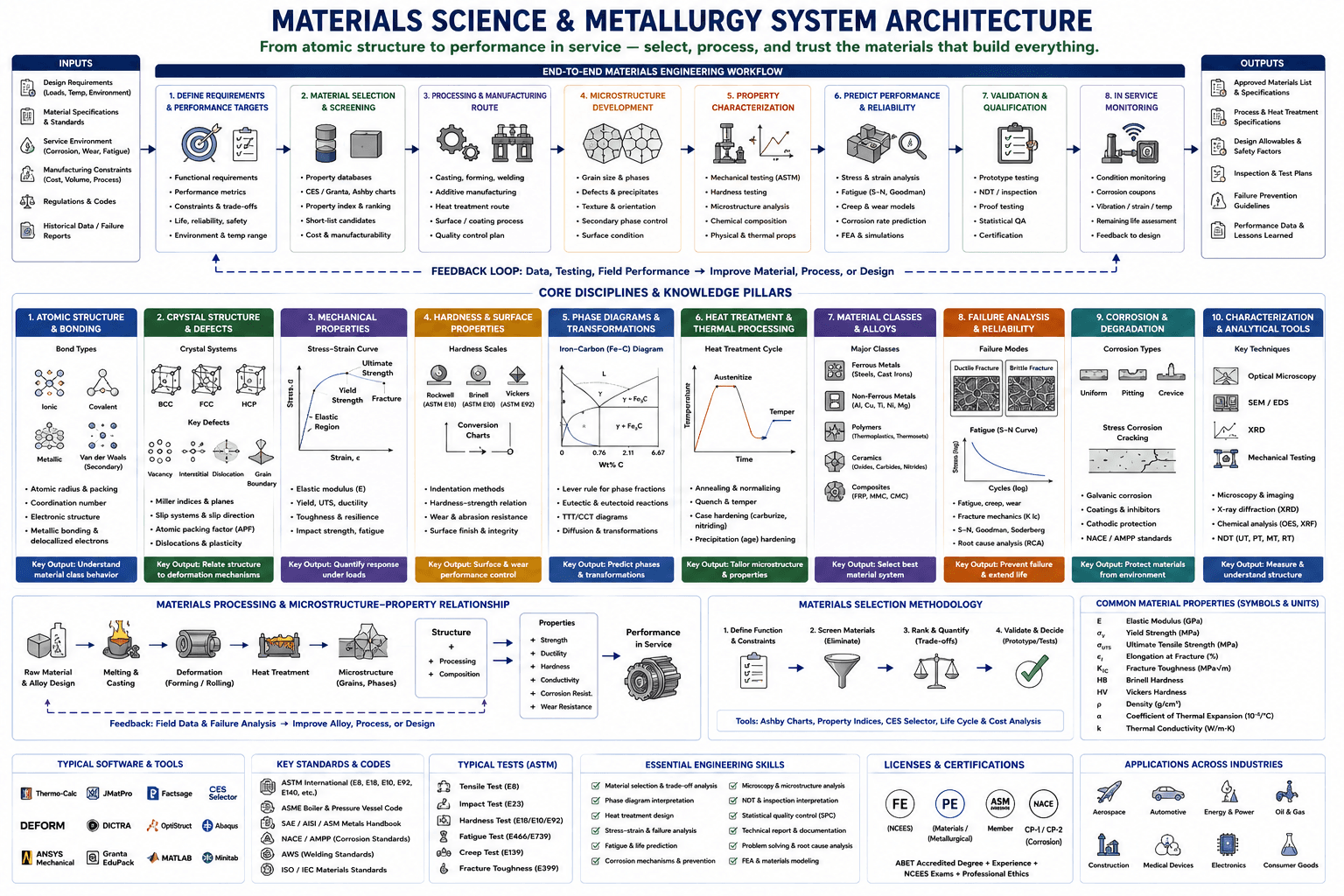
Hover, tap, or focus any component on the drawing (or a circuit below it) for details. Click to pin; move away or click again to clear.
Component Reference
Every component in the diagram above, grouped by section, with its role and the relevant standard.
Inputs
Design Requirements (Loads, Temp, Environment)
The mechanical loads, service temperatures, and environmental conditions the part must survive. These constraints seed the whole workflow — they drive which materials are even candidates before screening begins.
Material Specifications & Standards
Customer or industry material specifications — ASTM grades, SAE/AMS callouts, or internal engineering standards — that bound the acceptable chemistry, processing, and property ranges for the part.
Service Environment (Corrosion, Wear, Fatigue)
The chemical, abrasive, and cyclic-loading environment the component will see in service — humidity, chlorides, sliding contact, vibration — which drives corrosion, wear, and fatigue design margins.
Manufacturing Constraints (Cost, Volume, Process)
Target unit cost, production volume, and the manufacturing processes actually available (casting, forging, additive, machining) — constraints that can rule out an otherwise-ideal material on manufacturability alone.
Regulations & Codes
The regulatory and code framework the design must satisfy — ASME BPVC for pressure equipment, NACE/AMPP for corrosion service, AWS for welded structures — set before material selection can be finalized.
📘 ASME BPVC / NACE / AWSHistorical Data / Failure Reports
Field failure reports, warranty data, and prior lessons-learned on similar components — the single best predictor of where a new design is likely to fail, and a direct input to the failure-prevention loop.
Outputs
Approved Materials List & Specifications
The finalized, qualified material(s) and their governing specifications, released for use on the design — the deliverable that closes out material selection & screening.
Process & Heat Treatment Specifications
The documented processing route and heat-treatment schedule (temperatures, hold times, quench media) required to deliver the qualified microstructure and properties in production.
Design Allowables & Safety Factors
Allowable design stresses, strains, and safety factors derived from characterized properties — the numbers structural/stress analysts pull directly into their calculations.
Inspection & Test Plans
The inspection and test plan — sampling rates, NDT methods, and pass/fail acceptance criteria — that quality assurance executes to verify each production lot meets the qualified material.
Failure Prevention Guidelines
Design rules, operating limits, and maintenance guidance written to prevent the failure modes identified during characterization and root-cause analysis from recurring in service.
Performance Data & Lessons Learned
Field and test performance data captured for the next design cycle — the record that feeds the feedback loop back into requirements, material choice, and process for future programs.
Materials Engineering Workflow
1. Define Requirements & Performance Targets
The workflow opens by turning loads, environment, and manufacturing constraints into concrete functional requirements, performance metrics, life/reliability/safety targets, and the environment & temperature range the part must survive.
2. Material Selection & Screening
Candidate materials are pulled from property databases and ranked with CES/Granta or Ashby charts and property indices, then short-listed against cost and manufacturability before deeper analysis.
3. Processing & Manufacturing Route
The manufacturing route is locked in — casting, forming, welding, or additive manufacturing — along with the heat-treatment route, surface/coating process, and the quality control plan that will govern production.
4. Microstructure Development
Processing sets the microstructure: grain size and phase fractions, defects and precipitates, texture/orientation, secondary-phase control, and surface condition — the direct link between process and final properties.
5. Property Characterization
The as-processed material is characterized with mechanical testing (ASTM), hardness testing, microstructure analysis, chemical composition checks, and physical/thermal property measurement.
📘 ASTM E8 / E18 / E10 / E926. Predict Performance & Reliability
Characterized properties feed stress & strain analysis, fatigue (S-N, Goodman) and creep/wear models, corrosion-rate prediction, and FEA simulations to predict how the part will actually perform.
7. Validation & Qualification
Predictions are validated against reality — prototype testing, NDT/inspection, proof testing, statistical QA, and formal certification — before the material and process are released for production.
8. In-Service Monitoring
In service, condition monitoring, corrosion coupons, vibration/strain/temperature sensing, and remaining-life assessment track real performance and feed it back to design as the final workflow step.
Feedback Loop: Data, Testing, Field Performance
The dashed feedback loop closes the workflow: data from testing and field performance flows back to improve the material choice, process route, or design — the mechanism that keeps the whole system learning.
Atomic Structure & Bonding
Atomic Structure & Bonding — Bond Types
The four primary bond types — ionic, covalent, metallic, and van der Waals (secondary) bonding — that determine whether a material behaves as a hard brittle ceramic, a tough metal, or a weak molecular solid.
Atomic Structure & Bonding — Fundamentals
Atomic radius and packing, coordination number, electronic structure, and metallic bonding with delocalized electrons — the atomic-scale reasoning behind why different material classes behave so differently. Key output: understand material class behavior.
Crystal Structure & Defects
Crystal Structure & Defects — Crystal Systems
The three common metallic unit cells — BCC, FCC, HCP — alongside the key crystal defects (vacancy, interstitial, dislocation, grain boundary) that govern strength, ductility, and diffusion.
Crystal Structure & Defects — Slip & Packing
Miller indices and crystal planes, slip systems and slip direction, atomic packing factor (APF), and how dislocations move to produce plasticity. Key output: relate crystal structure to deformation mechanisms.
Mechanical Properties
Mechanical Properties — Stress-Strain Curve
The engineering stress-strain curve — elastic region, yield strength, ultimate strength, and fracture — is the single most-used chart in materials engineering, defining every allowable-stress calculation downstream.
📘 ASTM E8 (Tensile Testing)Mechanical Properties — Key Metrics
Elastic modulus (E), yield and ultimate tensile strength, ductility, toughness & resilience, and impact strength/fatigue resistance — the metrics used to quantify how a material responds to load. Key output: quantify response under loads.
Hardness & Surface Properties
Hardness & Surface Properties — Hardness Scales
The three common hardness scales — Rockwell (ASTM E18), Brinell (ASTM E10), and Vickers (ASTM E92) — plus the conversion charts used to translate between them and approximate tensile strength.
📘 ASTM E18 / E10 / E92, E140Hardness & Surface Properties — Wear & Finish
Indentation test methods, the hardness-strength relationship, wear & abrasion resistance, and surface finish/integrity — the properties that govern contact, sliding, and abrasive service. Key output: surface & wear performance control.
Phase Diagrams & Transformations
Phase Diagrams & Transformations — Iron-Carbon Diagram
The iron-carbon (Fe-Fe3C) phase diagram — showing austenite (γ), cementite (Fe3C), and the eutectoid/eutectic points at 0.76 and 2.11 wt% C — is the master map for predicting phases in every carbon and alloy steel.
Phase Diagrams & Transformations — Reactions
The lever rule for phase fractions, eutectic & eutectoid reactions, TTT/CCT transformation diagrams, and diffusion-controlled transformations used to predict microstructure from a cooling path. Key output: predict phases & transformations.
Heat Treatment & Thermal Processing
Heat Treatment & Thermal Processing — Heat Treatment Cycle
The generic heat-treatment cycle — austenitize, quench, and temper, plotted as temperature vs. time — is the thermal recipe engineers write to convert a chosen alloy into the target microstructure and properties.
Heat Treatment & Thermal Processing — Techniques
Annealing & normalizing, quench & temper, case hardening (carburizing, nitriding), and precipitation (age) hardening — the standard toolkit for tailoring microstructure to a property target. Key output: tailor microstructure & properties.
Material Classes & Alloys
Material Classes & Alloys
The five major material classes engineers choose from: ferrous metals (steels, cast irons), non-ferrous metals (Al, Cu, Ti, Ni, Mg), polymers (thermoplastics, thermosets), ceramics (oxides, carbides, nitrides), and composites (FRP, MMC, CMC). Key output: select the best material system for the application.
📘 SAE / AISI / ASM Metals HandbookFailure Analysis & Reliability
Failure Analysis & Reliability — Failure Modes
Ductile fracture (dimpled, high-energy) versus brittle fracture (flat, low-energy) fractography, shown alongside the fatigue S-N curve that plots stress amplitude against cycles-to-failure on a log scale.
📘 ASTM E399 (Fracture Toughness)Failure Analysis & Reliability — Analysis Methods
Fatigue, creep, and wear failure mechanisms; fracture mechanics (KIc); the S-N, Goodman, and Soderberg fatigue criteria; and root cause analysis (RCA) used to diagnose in-service failures. Key output: prevent failure & extend life.
📘 ASTM E466 / E739 (Fatigue)Corrosion & Degradation
Corrosion & Degradation — Corrosion Types
The common corrosion morphologies — uniform, pitting, and crevice corrosion — plus stress corrosion cracking (SCC), where tensile stress and a corrosive environment combine to crack an otherwise-ductile material.
📘 NACE/AMPP StandardsCorrosion & Degradation — Protection Methods
Galvanic corrosion between dissimilar metals, coatings & inhibitors, cathodic protection, and the NACE/AMPP standards that govern corrosion-service design. Key output: protect materials from the environment.
📘 NACE/AMPP StandardsCharacterization & Analytical Tools
Characterization & Analytical Tools — Key Techniques
The core analytical toolkit: optical microscopy, SEM/EDS (scanning electron microscopy with elemental analysis), X-ray diffraction (XRD), and mechanical testing — the instruments that turn a sample into data.
Characterization & Analytical Tools — Applications
Microscopy & imaging, X-ray diffraction phase identification, chemical analysis (OES, XRF), and non-destructive testing (UT, PT, MT, RT) used to verify composition and detect flaws. Key output: measure & understand structure.
📘 ASTM E3 / NDT Methods (UT/PT/MT/RT)Processing & Microstructure-Property Relationship
Raw Material & Alloy Design
The process chain begins with raw material and alloy design — selecting the base composition (major element + alloying additions) that will be melted, cast, and processed into the final part.
Melting & Casting
The alloy is melted and cast to a near-net or ingot shape. Cooling rate during solidification sets the initial grain structure and any casting defects (porosity, segregation) that carry forward into later stages.
Deformation (Forming / Rolling)
Mechanical deformation — rolling, forging, extrusion, or other forming — breaks down the cast grain structure, closes internal porosity, and introduces the strain that later drives recrystallization and grain refinement.
Heat Treatment
Heat treatment (annealing, quenching, tempering, aging) transforms the deformed structure into the target phase mix and grain size — the direct lever between processing route and final microstructure.
Microstructure (Grains, Phases)
The resulting grain size and phase distribution — the microstructure — is the physical outcome of every upstream processing choice, and the direct input to the structure-processing-composition relationship that sets properties.
Structure + Processing + Composition
The central materials-science relationship: structure, processing, and composition together determine every downstream property. Change any one of the three and the resulting properties shift with it.
Properties (Strength, Ductility, Hardness…)
The measurable properties that fall out of structure, processing, and composition: strength, ductility, hardness, conductivity, corrosion resistance, and wear resistance — the same metrics characterized earlier in the workflow.
Performance in Service
Properties translate to real-world performance in service — the final proof point of the entire structure-processing-composition chain, and the source of the field data that feeds the process feedback loop.
Feedback: Field Data & Failure Analysis
Field data and failure analysis feed back to improve the alloy, the process, or the design — closing the microstructure-property loop the same way the top-level workflow closes its own feedback loop.
Materials Selection Methodology
1. Define Function & Constraints
The first step of the Ashby-style selection method: define the part’s function, the free variables, and the constraints (geometry, environment, cost) before any material is evaluated.
2. Screen Materials (Eliminate)
Materials that fail a hard constraint — maximum service temperature, corrosion resistance, or a minimum property threshold — are screened out, narrowing a large database down to a workable candidate list.
3. Rank & Quantify (Trade-offs)
Surviving candidates are ranked by material property indices (e.g. strength-to-weight, stiffness-to-cost) that quantify the trade-offs between competing performance and cost objectives.
4. Validate & Decide (Prototype/Tests)
The top-ranked candidate is validated with prototypes and physical tests before final selection — the check that catches anything the property database and indices alone could not capture.
Tools: Ashby Charts, Property Indices, CES Selector, Life Cycle & Cost Analysis
The standard toolkit for this methodology: Ashby material-property charts, property indices, the CES/Granta Selector database, and life-cycle & cost analysis — used together across all four selection steps.
Common Material Properties
Common Material Properties — Mechanical Symbols
The standard mechanical-property symbols engineers use throughout the workflow: E (elastic modulus, GPa), σy (yield strength, MPa), σUTS (ultimate tensile strength, MPa), εf (elongation at fracture, %), and KIc (fracture toughness, MPa√m).
Common Material Properties — Hardness & Physical Symbols
The hardness and physical-property symbols: HB (Brinell hardness), HV (Vickers hardness), ρ (density, g/cm³), α (coefficient of thermal expansion, 10⁻⁶/°C), and k (thermal conductivity, W/m·K).
Software & Tools
Thermo-Calc
Thermo-Calc computes multi-component phase equilibria and thermodynamic properties — the industry-standard tool for predicting phase diagrams and solidification paths for complex alloys.
JMatPro
JMatPro simulates material properties (phase transformations, mechanical and physical properties) as a function of composition and process history, widely used for alloy and heat-treatment development.
FactSage
FactSage combines a thermochemical database system with Gibbs-energy minimization software, used for phase equilibria, slag chemistry, and thermodynamic modeling in metallurgy.
CES Selector
CES Selector (Granta/Ansys) is the standard software implementation of Ashby-method material selection, with a searchable database of material properties, charts, and cost/eco data.
DEFORM
DEFORM simulates metal-forming processes (forging, extrusion, rolling) and coupled heat treatment, predicting material flow, stresses, and microstructure evolution during manufacturing.
DICTRA
DICTRA simulates diffusion-controlled phase transformations in multi-component alloys — used for case hardening, homogenization, and coating diffusion modeling.
OptiStruct
OptiStruct (Altair) is a structural analysis and optimization solver used for topology, size, and shape optimization of parts against material and manufacturing constraints.
Abaqus
Abaqus is a general-purpose FEA suite widely used for nonlinear structural, thermal, and material-model simulation, including advanced constitutive models for metals, polymers, and composites.
ANSYS Mechanical
ANSYS Mechanical is a leading FEA platform for structural, thermal, and fatigue simulation, used to validate the stress and reliability predictions made earlier in the workflow.
Granta EduPack
Granta EduPack is the education edition of the CES material database, teaching Ashby-method material selection with property charts and eco-design data.
MATLAB
MATLAB is used throughout materials engineering for statistical analysis, curve fitting (S-N curves, Goodman diagrams), and custom property or reliability modeling.
Minitab
Minitab is a statistics package used for statistical process control (SPC), design of experiments (DOE), and capability analysis on material and process qualification data.
Standards, Codes & Tests
Key Standards & Codes
The standards families that govern materials engineering: ASTM International (E8, E18, E10, E92, E140, etc.) for test methods, the ASME Boiler & Pressure Vessel Code for pressure equipment, SAE/AISI/ASM Metals Handbook for alloy data, NACE/AMPP for corrosion, AWS for welding, and ISO/IEC materials standards.
📘 ASTM / ASME / SAE-AISI-ASM / NACE-AMPP / AWS / ISO-IECTensile Test (E8)
ASTM E8 is the standard test method for tension testing of metallic materials — the source of the stress-strain curve, yield strength, UTS, and elongation values used across the workflow.
📘 ASTM E8Impact Test (E23)
ASTM E23 covers notched-bar (Charpy and Izod) impact testing, measuring absorbed energy to characterize a material’s toughness and ductile-to-brittle transition temperature.
📘 ASTM E23Hardness Test (E18/E10/E92)
The three main hardness test standards — Rockwell (E18), Brinell (E10), and Vickers (E92) — used for quick, non-destructive strength and quality checks in production.
📘 ASTM E18 / E10 / E92Fatigue Test (E466/E739)
ASTM E466 (constant-amplitude fatigue testing) and E739 (statistical analysis of S-N data) are the standards behind the fatigue S-N curves used in fatigue-life prediction.
📘 ASTM E466 / E739Creep Test (E139)
ASTM E139 covers creep, creep-rupture, and stress-rupture testing of metallic materials at elevated temperature — essential data for high-temperature service (turbines, pressure vessels, piping).
📘 ASTM E139Fracture Toughness (E399)
ASTM E399 is the standard test method for plane-strain fracture toughness (KIc) of metallic materials, the property that governs critical flaw size in fracture-mechanics-based design.
📘 ASTM E399Skills, Licenses & Applications
Essential Engineering Skills
The core skill set spans material selection & trade-off analysis, phase diagram interpretation, heat treatment design, stress-strain & failure analysis, fatigue & life prediction, corrosion mechanisms & prevention, microscopy & microstructure analysis, NDT & inspection interpretation, statistical quality control (SPC), technical report & documentation, problem solving & root cause analysis, and FEA & materials modeling.
FE (NCEES)
The NCEES Fundamentals of Engineering (FE) exam is the first step toward PE licensure, typically taken near graduation to establish Engineer-in-Training status.
📘 NCEES FE ExamPE (Materials / Metallurgical)
The Professional Engineer (PE) license in Materials & Metallurgical Engineering is earned after a qualifying degree, several years of supervised experience, and passing the NCEES PE exam — the credential required to stamp engineering work in most U.S. jurisdictions. Typically built on an ABET-accredited degree plus experience, the NCEES FE and PE exams, and adherence to professional ethics.
📘 NCEES PE — Materials/MetallurgicalASM Member
Membership in ASM International, the materials-science professional society, provides access to the Metals Handbook, technical committees, and continuing-education resources.
NACE CP-1/CP-2 (Corrosion)
NACE/AMPP CP-1 and CP-2 are cathodic-protection technician/technologist certifications, credentialing engineers to design and inspect corrosion-protection systems on pipelines and structures.
📘 NACE/AMPP CP-1 / CP-2Aerospace
Aerospace pushes materials engineering hardest on weight, fatigue life, and fracture toughness — titanium and aluminum alloys, nickel superalloys, and composites all trace back to this diagram’s workflow.
Automotive
Automotive applications balance cost, weight, and crashworthiness — advanced high-strength steels, aluminum body panels, and fatigue-critical drivetrain components are all materials-selection problems.
Energy & Power
Energy & power generation demands creep-resistant superalloys for turbine blades, pressure-vessel steels rated to ASME BPVC, and corrosion-resistant materials for boiler and steam systems.
Oil & Gas
Oil & gas materials must resist sour-service cracking, high pressure, and aggressive corrosion — governed heavily by NACE/AMPP standards for pipeline and downhole equipment.
Construction
Construction relies on structural steel, reinforcing bar, and weldable alloys selected for strength, weldability (AWS), and long-term corrosion and fatigue performance in structures.
Medical Devices
Medical devices demand biocompatible, corrosion-resistant materials — titanium, 316L stainless steel, and cobalt-chrome alloys — for implants and surgical instruments.
Electronics
Electronics applications lean on the electrical/thermal conductivity properties (k, electronic structure) covered earlier — copper interconnects, solder alloys, and heat-sink materials.
Consumer Goods
Consumer goods are typically the most cost- and manufacturability-driven materials decisions — polymers, coatings, and low-cost alloys chosen through the same selection methodology at a different price point.
Connections & Flows
The workflow sequence and the two feedback loops that tie the diagram together — each shown as a colored line in the legend above.
Workflow Sequence
The solid navy arrows that carry the part through the 8-step materials engineering workflow, and through the raw-material-to-performance processing chain, in order.
Workflow Feedback Loop
The dashed loop beneath the 8-step workflow: data, testing, and field performance flow back to improve the material, process, or design — the mechanism that keeps the whole materials engineering workflow iterating.
Processing Feedback Loop
The dashed loop beneath the materials processing & microstructure-property chain: field data and failure analysis flow back to improve the alloy, the process route, or the design.