STEM Fundamentals System Architecture
The full 7-step end-to-end STEM learning journey (assess & plan, learn concepts, practice & calculate, apply & connect, test & review, master & retain, and certify & advance) with its continuous measure–analyze–learn–improve feedback loop, the 6 core STEM fundamental domains that underlie every engineering discipline — Calculus & Differential Equations, Linear Algebra, Mechanics, Chemistry, Probability & Statistics, and Trigonometry — each with its key concepts, a worked example, and a key output, how those domains connect to structural, mechanical, electrical, chemical, civil, and aerospace engineering, and how it all aligns to the NCEES FE Reference Handbook. Hover, tap, or focus any component for its description and standard reference.
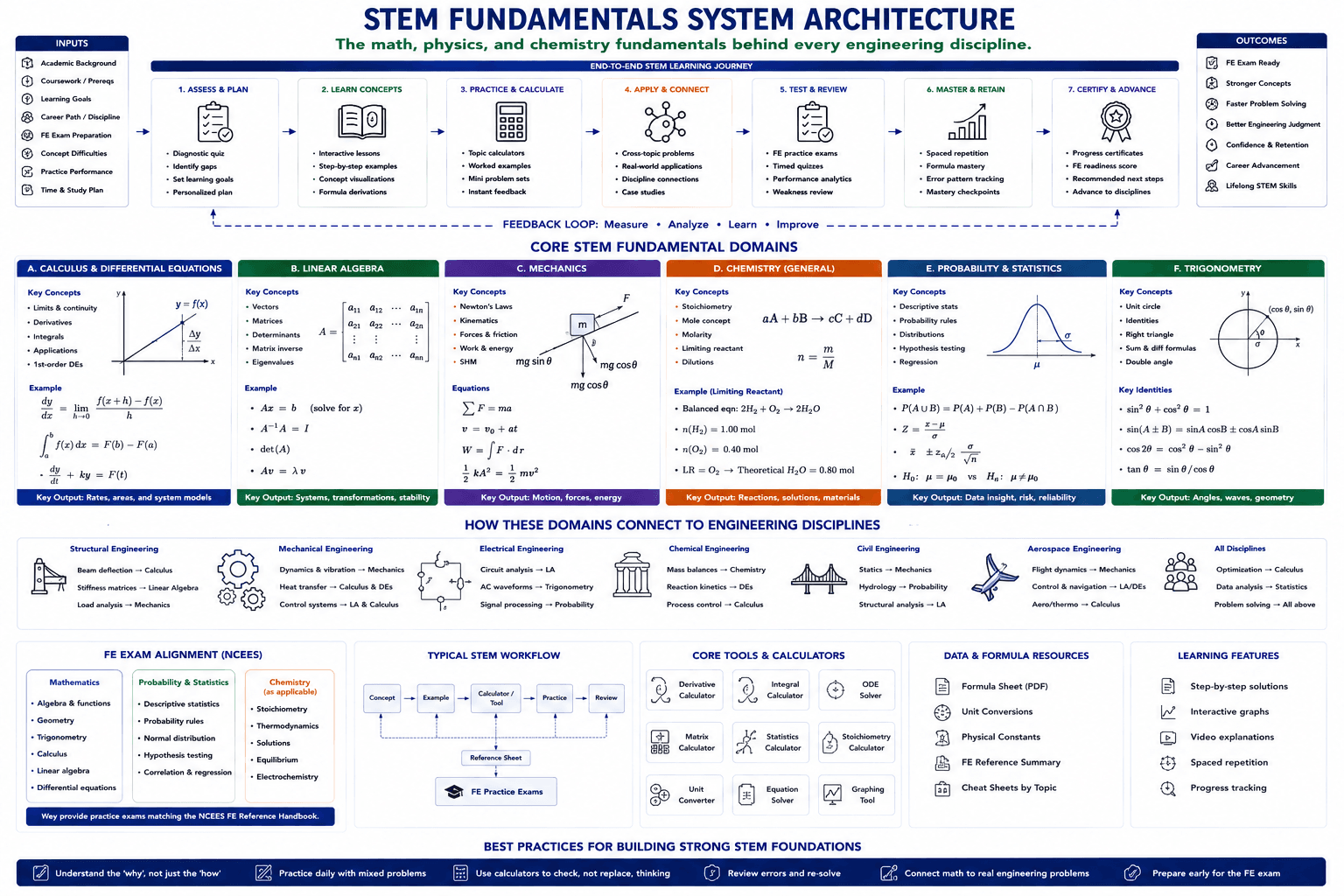
Hover, tap, or focus any component on the drawing (or a circuit below it) for details. Click to pin; move away or click again to clear.
Component Reference
Every component in the diagram above, grouped by section, with its role and the relevant standard.
Inputs
Academic Background
The learner’s starting point — prior high-school or college math, physics, and chemistry coursework. Sets the baseline the diagnostic quiz calibrates against before building a personalized plan.
Coursework / Prereqs
The specific courses a learner has completed or still needs — algebra through calculus, general chemistry, intro physics — used to sequence which STEM Learning Journey steps are most urgent.
Learning Goals
The learner’s stated objective — pass the FE exam, refresh fundamentals before an engineering course, or build confidence with a specific topic like differential equations or statistics.
Career Path / Discipline
The engineering discipline the learner is heading toward — structural, mechanical, electrical, chemical, civil, aerospace, or general — which weights which domains (Mechanics vs. Circuits vs. Chemistry) matter most.
FE Exam Preparation
Whether the learner is actively studying for the NCEES Fundamentals of Engineering exam, and on what timeline — drives how much emphasis the plan places on FE-aligned practice exams and the FE Reference Handbook.
Concept Difficulties
Self-reported or diagnostic-quiz-detected weak spots — e.g. eigenvalues, hypothesis testing, or stoichiometry — that the Practice & Calculate and Test & Review steps target directly.
Practice Performance
Ongoing performance data from mini problem sets, timed quizzes, and FE practice exams — the signal the spaced-repetition and error-pattern-tracking features use to adjust the plan.
Time & Study Plan
How much time the learner can commit and over what horizon — shapes the pacing of the 7-step STEM Learning Journey and how aggressively the FE exam countdown is scheduled.
Outcomes
FE Exam Ready
The learner reaches a readiness level matched to the NCEES FE Reference Handbook — comfortable with the Mathematics, Probability & Statistics, and Chemistry sections that appear on the exam.
Stronger Concepts
A durable, first-principles understanding of the six core domains — not just formula memorization — that transfers into every downstream engineering course.
Faster Problem Solving
Practiced fluency with the core tools and calculators means less time hunting for a method and more time applying it — a direct product of repeated worked-example practice.
Better Engineering Judgment
The ability to recognize when a calculated answer is physically or mathematically unreasonable — a skill that only comes from connecting the math to real engineering context.
Confidence & Retention
Spaced repetition and mastery checkpoints keep the fundamentals from decaying between the time they’re learned and the time they’re needed in an upper-level course or on the job.
Career Advancement
A strong STEM foundation is the prerequisite for advancing confidently into any of the site’s discipline-specific studios — structural, mechanical, electrical, chemical, and beyond.
Lifelong STEM Skills
Calculus, linear algebra, mechanics, chemistry, probability & statistics, and trigonometry are permanent tools — mastering them once pays off across an entire engineering career, not just one exam cycle.
STEM Learning Journey
1. Assess & Plan
The journey opens with a diagnostic quiz that identifies gaps against the learner’s goals, then sets learning goals and produces a personalized study plan — the same input the Time & Study Plan and Concept Difficulties inputs feed.
2. Learn Concepts
Interactive lessons, step-by-step examples, concept visualizations, and formula derivations build first-principles understanding before any calculation is attempted — the foundation the six domain panels below are drawn from.
3. Practice & Calculate
Topic calculators, worked examples, mini problem sets, and instant feedback turn passive understanding into active calculation skill — this is where the Core Tools & Calculators panel gets used.
4. Apply & Connect
Cross-topic problems, real-world applications, discipline connections, and case studies tie the math back to the engineering context it will actually be used in — see the discipline-connection cards below.
5. Test & Review
FE practice exams, timed quizzes, performance analytics, and weakness review measure how well the learning has stuck and surface exactly which domain needs more repetition.
6. Master & Retain
Spaced repetition, formula mastery drills, error-pattern tracking, and mastery checkpoints lock the fundamentals into long-term memory rather than letting them fade after the first pass.
7. Certify & Advance
Progress certificates, an FE readiness score, and recommended next steps close the loop — advancing the learner from STEM fundamentals into a specific engineering discipline studio.
Feedback Loop: Measure · Analyze · Learn · Improve
A continuous feedback loop — measure performance, analyze the pattern, learn what’s missing, improve the plan — routes weak spots detected anywhere downstream back to the Assess & Plan step rather than treating the journey as one-and-done.
📘 Continuous-improvement (PDCA-style) loopCalculus & Differential Equations
Calculus — Key Concepts
Limits & continuity, derivatives, integrals, applications, and first-order differential equations — the toolkit for describing rates of change and accumulation that underlies dynamics, heat transfer, and control systems.
📘 NCEES FE Reference Handbook — CalculusCalculus — Function Graph
A plotted function y = f(x) with the secant/tangent slope Δy/Δx illustrated — the visual definition of a derivative as a rate of change, which the limit-based formal definition below makes precise.
Calculus — Worked Example
The formal limit definition of the derivative dy/dx = limₕ→₀[f(x+h)−f(x)]/h, the Fundamental Theorem of Calculus ∫ f(x)dx = F(b)−F(a), and a first-order linear ODE dy/dt + ky = F(t) worked side by side.
📘 NCEES FE Reference Handbook — CalculusCalculus — Key Output
What mastering this domain unlocks: computing rates, areas under curves, and building the differential-equation models that describe how any physical system changes over time.
Linear Algebra
Linear Algebra — Key Concepts
Vectors, matrices, determinants, the matrix inverse, and eigenvalues — the algebra of systems of linear equations that underlies stiffness matrices, circuit analysis, and control-system state-space models.
📘 NCEES FE Reference Handbook — Linear AlgebraLinear Algebra — Matrix Notation
A general matrix A with entries aᵢⱼ arranged in rows and columns — the notation used throughout the worked example for solving systems, inverting, and finding eigenvalues.
Linear Algebra — Worked Example
Solving Ax = b for x, the inverse identity A⁻¹A = I, the determinant det(A), and the eigenvalue equation Av = λv — the four operations a linear-algebra calculator needs to automate.
📘 NCEES FE Reference Handbook — Linear AlgebraLinear Algebra — Key Output
What mastering this domain unlocks: solving systems of equations, understanding geometric transformations, and assessing the stability of dynamic systems via eigenvalues.
Mechanics
Mechanics — Key Concepts
Newton's Laws, kinematics, forces & friction, work & energy, and simple harmonic motion — the physics of how objects move and what makes them move that way.
📘 NCEES FE Reference Handbook — Statics & DynamicsMechanics — Incline Force Diagram
A classic block-on-an-incline free-body diagram showing the applied force F, the gravity components mg sinθ (down-slope) and mg cosθ (into the surface) — the canonical setup for a friction/Newton’s-second-law problem.
Mechanics — Equations
Newton's second law ΣF = ma, the kinematic equation v = v₀ + at, the work-energy definition W = ∫F·dr, and the SHM energy balance ½kA² = ½mv² worked together as the core mechanics equation set.
📘 NCEES FE Reference Handbook — DynamicsMechanics — Key Output
What mastering this domain unlocks: predicting motion, resolving forces on a structure or machine, and tracking energy through a mechanical system.
Chemistry (General)
Chemistry — Key Concepts
Stoichiometry, the mole concept, molarity, limiting reactant, and dilutions — the quantitative backbone of reaction chemistry used in process, environmental, and materials engineering.
📘 NCEES FE Reference Handbook — ChemistryChemistry — Reaction & Molarity Formulas
The general balanced-reaction template aA + bB → cC + dD alongside the mole formula n = m/M (moles = mass ÷ molar mass) — the two relationships every stoichiometry problem starts from.
Chemistry — Limiting Reactant Example
A worked limiting-reactant problem: the balanced equation 2H₂ + O₂ → 2H₂O, given n(H₂) = 1.00 mol and n(O₂) = 0.40 mol, solved to find O₂ as the limiting reagent and a theoretical yield of 0.80 mol H₂O.
📘 NCEES FE Reference Handbook — ChemistryChemistry — Key Output
What mastering this domain unlocks: balancing reactions, preparing solutions to a target concentration, and reasoning about material composition and yield.
Probability & Statistics
Probability & Statistics — Key Concepts
Descriptive statistics, probability rules, distributions, hypothesis testing, and regression — the toolkit behind quality control, reliability engineering, and risk analysis.
📘 NCEES FE Reference Handbook — Probability & StatisticsProbability & Statistics — Normal Distribution
The normal (Gaussian) distribution bell curve centered on the mean μ, with the standard deviation σ marking the spread — the single most common distribution assumption in engineering statistics.
Probability & Statistics — Worked Example
The addition rule P(A∪B) = P(A) + P(B) − P(A∩B), the Z-score Z = (x−μ)/σ, a confidence interval x̄ ± z_{α/2}·σ/√n, and a hypothesis test H₀: μ = μ₀ vs. Hₐ: μ ≠ μ₀ — the four building blocks of inferential statistics.
📘 NCEES FE Reference Handbook — Probability & StatisticsProbability & Statistics — Key Output
What mastering this domain unlocks: drawing sound conclusions from data, quantifying risk, and assessing the reliability of a component, process, or system.
Trigonometry
Trigonometry — Key Concepts
The unit circle, trig identities, right-triangle relationships, sum & difference formulas, and double-angle formulas — the geometry of angles that underlies AC waveforms, vibration, and vector components.
📘 NCEES FE Reference Handbook — TrigonometryTrigonometry — Unit Circle
The unit circle with a point at (cosθ, sinθ) and angle θ measured from the positive x-axis — the geometric definition every trig identity and exact-value table is built from.
Trigonometry — Key Identities
The Pythagorean identity sin²θ + cos²θ = 1, the angle-sum identity sin(A±B) = sinA·cosB ± cosA·sinB, the double-angle formula cos2θ = cos²θ − sin²θ, and the tangent ratio tanθ = sinθ/cosθ.
📘 NCEES FE Reference Handbook — TrigonometryTrigonometry — Key Output
What mastering this domain unlocks: resolving vectors and angles, describing periodic waves and AC signals, and solving geometric layout problems.
Engineering Discipline Connections
Structural Engineering
Beam deflection draws on Calculus, stiffness matrices draw on Linear Algebra, and load analysis draws on Mechanics — the three STEM domains a structural engineer leans on daily.
Mechanical Engineering
Dynamics & vibration draw on Mechanics, heat transfer draws on Calculus & Differential Equations, and control systems draw on Linear Algebra & Calculus together.
Electrical Engineering
Circuit analysis draws on Linear Algebra, AC waveforms draw on Trigonometry, and signal processing draws on Probability — the STEM domains behind every electrical engineering course.
Chemical Engineering
Mass balances draw on Chemistry, reaction kinetics draw on Differential Equations, and process control draws on Calculus — the STEM domains a chemical engineer applies at the plant.
Civil Engineering
Statics draws on Mechanics, hydrology draws on Probability & Statistics, and structural analysis draws on Linear Algebra — the STEM foundation behind bridges, dams, and site design.
Aerospace Engineering
Flight dynamics draws on Mechanics, control & navigation draw on Linear Algebra & Differential Equations, and aerodynamics/thermodynamics draw on Calculus.
All Disciplines
Optimization draws on Calculus, data analysis draws on Statistics, and general problem solving draws on every domain above — the reason STEM Learning is the shared studio underneath all 27 others.
FE Exam Alignment (NCEES)
FE Alignment — Mathematics
Algebra & functions, geometry, trigonometry, calculus, linear algebra, and differential equations — the full Mathematics section of the NCEES FE exam, each topic covered by a domain panel above.
📘 NCEES FE Reference Handbook — MathematicsFE Alignment — Probability & Statistics
Descriptive statistics, probability rules, normal distribution, hypothesis testing, and correlation & regression — the Probability & Statistics section of the NCEES FE exam.
📘 NCEES FE Reference Handbook — Probability & StatisticsFE Alignment — Chemistry (as applicable)
Stoichiometry, thermodynamics, solutions, equilibrium, and electrochemistry — the Chemistry section that appears on the NCEES FE exam for applicable disciplines.
📘 NCEES FE Reference Handbook — ChemistryFE Reference Handbook Alignment Note
A direct commitment: every practice exam on this studio is built to match the topic coverage and notation of the official NCEES FE Reference Handbook, so practice transfers directly to exam day.
📘 NCEES FE Reference HandbookTypical STEM Workflow
Workflow — Concept
Every problem starts with the concept — what the math or physics idea actually means — before any formula or calculator is touched. This is Step 2 (Learn Concepts) of the STEM Learning Journey in miniature.
Workflow — Example
A fully worked example shows the concept applied end to end — the same pattern as the "Example" section in every domain panel above (e.g. the limiting-reactant or eigenvalue worked examples).
Workflow — Calculator / Tool
The learner applies the concept using one of the site’s real calculators — Derivative & Limit, Matrix Operations, Stoichiometry, and the rest of the Core Tools & Calculators panel below.
Workflow — Practice
Repetition across varied problems — not just one — is what converts a single worked example into a transferable skill; mirrors Step 3 (Practice & Calculate) of the learning journey.
Workflow — Review
A review pass checks results against the reference sheet and error patterns, then feeds back into the Concept and Example stages via the dashed feedback arrows shown below the workflow boxes.
Workflow — Reference Sheet
A condensed formula and constant reference sheet sits beneath the Calculator/Tool stage — the same content as the Data & Formula Resources panel, kept close at hand while working problems.
Workflow — FE Practice Exams
The reference sheet feeds directly into FE Practice Exams — the workflow isn’t just for building understanding, it’s the same loop used to prepare for the NCEES FE exam.
Core Tools & Calculators
Derivative Calculator
Evaluates the power-rule derivative of a·xⁿ at a point and cross-checks it against a numerical central-difference estimate — the live tool behind the Calculus & Differential Equations domain.
Integral Calculator
Computes definite integrals and the Fundamental Theorem of Calculus relationship ∫ f(x)dx = F(b) − F(a) shown in the Calculus worked example above.
ODE Solver
Solves first-order differential equations like dy/dt + ky = F(t) — the numerical-methods counterpart to the analytic Calculus & Differential Equations domain.
Matrix Calculator
Computes the determinant, trace, and inverse of a 2×2 or 3×3 matrix with cofactor expansion shown step by step — the live tool behind the Linear Algebra domain.
Statistics Calculator
Computes descriptive statistics, Z-scores, confidence intervals, and hypothesis tests — the live tool behind the Probability & Statistics domain worked example.
Stoichiometry Calculator
Enter reaction coefficients and available moles to find the limiting reagent, moles of product formed, and theoretical yield — the exact tool used in the Chemistry limiting-reactant worked example.
Unit Converter
Converts between the engineering units that appear throughout every domain — length, force, energy, concentration — feeding directly from the Data & Formula Resources panel’s Unit Conversions reference.
Equation Solver
Solves algebraic equations, including ax² + bx + c = 0 via the quadratic formula with discriminant, roots, vertex, and axis of symmetry.
Graphing Tool
Plots functions and data interactively — the same visualization style used for the function graph, normal-distribution curve, and unit circle shown in the domain panels above.
Data & Formula Resources
Formula Sheet (PDF)
A printable, condensed reference of the formulas from all six core domains — the same content that anchors the Reference Sheet stage of the Typical STEM Workflow.
Unit Conversions
A reference table of common engineering unit conversions, backing the Unit Converter tool in the Core Tools & Calculators panel.
Physical Constants
Standard physical and chemical constants — gas constant, Avogadro’s number, gravitational acceleration — needed to complete calculations in the Mechanics and Chemistry domains.
FE Reference Summary
A condensed summary aligned to the NCEES FE Reference Handbook’s notation and formula presentation, so practice with these resources maps directly onto what’s allowed on exam day.
📘 NCEES FE Reference HandbookCheat Sheets by Topic
One-page cheat sheets for each of the six core domains — Calculus, Linear Algebra, Mechanics, Chemistry, Probability & Statistics, and Trigonometry — for fast pre-exam review.
Learning Features
Step-by-Step Solutions
Every calculator on the studio shows its full working — cofactor expansion, limit evaluation, stoichiometric ratios — rather than just a final number, matching the site’s show-the-work convention.
Interactive Graphs
Function graphs, the normal distribution curve, and the unit circle respond to learner input rather than staying static — reinforcing the concept visualizations from Step 2 of the learning journey.
Video Explanations
Short video walkthroughs supplement the written lessons for learners who prefer a spoken, worked-through explanation of a concept.
Spaced Repetition
Automatically resurfaces previously-learned material at increasing intervals — the mechanism behind Step 6 (Master & Retain) of the STEM Learning Journey.
Progress Tracking
Tracks mastery across all six core domains and FE-exam readiness over time, feeding the Progress Certificates and FE Readiness Score produced in Step 7 (Certify & Advance).
Best Practices
Understand the 'why', not just the 'how'
Memorizing a formula without understanding why it works breaks down the moment a problem looks slightly different — always connect back to Step 2 (Learn Concepts) first.
Practice daily with mixed problems
Short, daily practice sessions mixing topics build more durable skill than infrequent, single-topic cramming — the rationale behind spaced repetition.
Use calculators to check, not replace, thinking
The Core Tools & Calculators are for checking work and speeding up routine computation — not a substitute for understanding the concept behind the calculation.
Review errors and re-solve
Reviewing exactly where and why an answer went wrong — then re-solving from scratch — is the single highest-value use of study time, and what the Review workflow stage is built for.
Connect math to real engineering problems
Tying every formula back to a real engineering problem — a beam, a circuit, a reaction — is what makes the STEM Learning Journey’s "Apply & Connect" step so important.
Prepare early for the FE exam
Starting FE exam preparation early — rather than cramming in the final weeks — gives spaced repetition time to work and leaves room to shore up weak domains before test day.
Connections & Flows
The feedback paths that tie the diagram together — each shown as a colored line in the legend above.
Feedback Loop
The dashed arrow routing weak spots detected in Test & Review or Master & Retain back to Assess & Plan — the STEM Learning Journey is cyclical, continuously re-measuring and re-planning rather than running once end to end.
Workflow Review Loop
The dashed arrows beneath the Typical STEM Workflow that route the Review stage’s findings back into Concept, Example, Calculator/Tool, and Practice — the same feedback principle applied at the single-problem level.