Skill Roadmap Series · Free illustrated guide

Artificial Intelligence & Machine Learning Roadmap

Move from Python and data preparation to baseline models, evaluation and a small deployed learning prototype.

Complete beginner7 practical stagesFreeUpdated
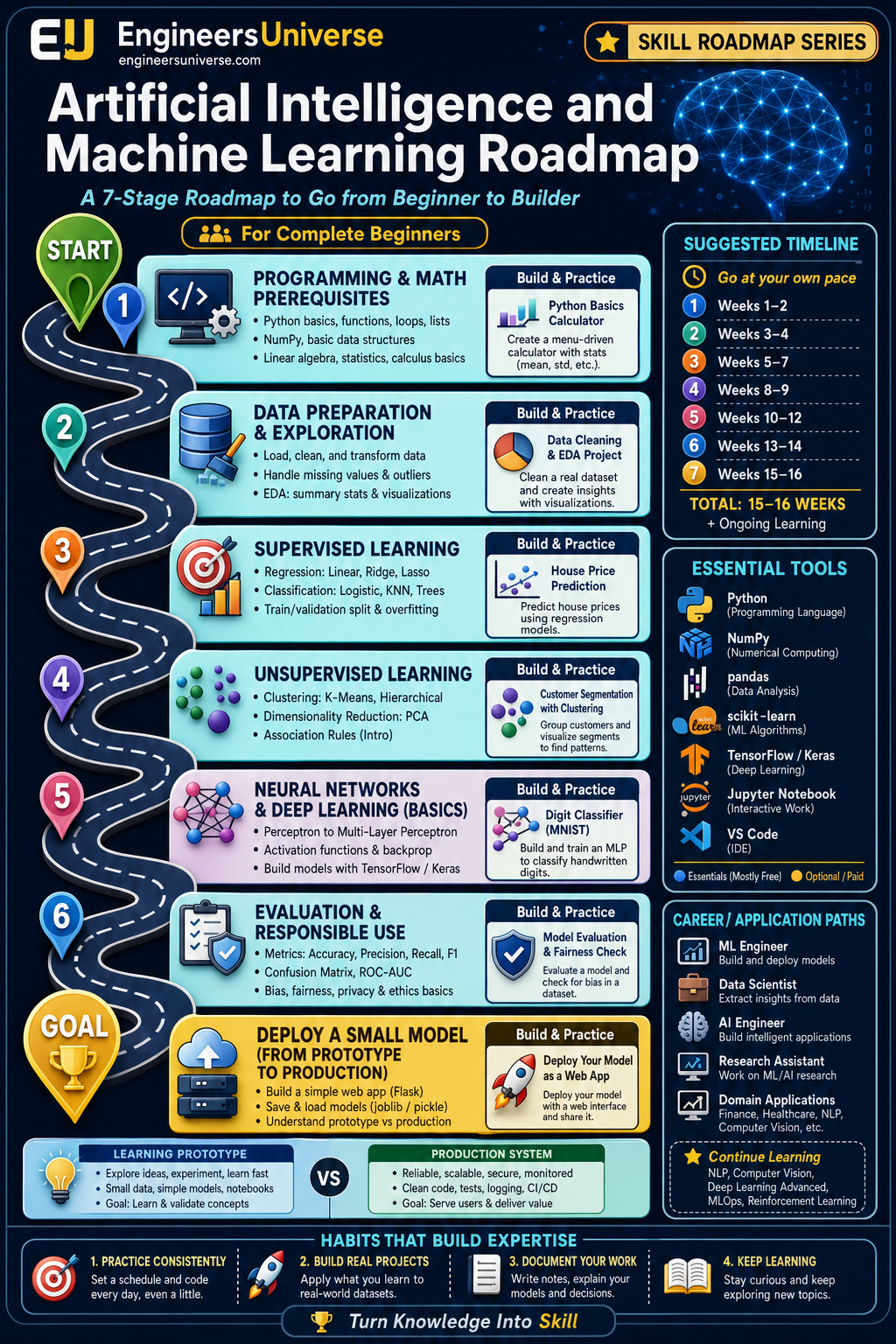
Artificial Intelligence & Machine Learning Roadmap — seven-stage learning path. Read every stage in the companion guide below.
100%

Scroll to explore. Zoom is relative to the viewer width. Press Escape to close.

Artificial Intelligence & Machine Learning Roadmap — original illustrated roadmap; a complete text guide follows on this page.
Download original PNG

How to use this roadmap

Read the illustration for the big picture, then work through the stage guide below. Each stage gives you a practical task and a “Ready to move on?” checkpoint. Save the project, tests and notes as evidence of your progress.

Seven stages, from beginner to builder

The poster allocates weeks 1–16 and labels the total 15–16 weeks. Treat this as a flexible sequence: programming and mathematics may take longer, and production operation requires more work than deploying a prototype.

The original supplied poster is preserved as provided. The companion text clarifies timing and practice boundaries. You can repeat or extend any stage.

Jump to a stage

  1. 1. Programming and mathematics prerequisites
  2. 2. Data preparation and exploration
  3. 3. Supervised learning
  4. 4. Unsupervised learning
  5. 5. Neural networks and deep-learning basics
  6. 6. Evaluation and responsible use
  7. 7. Deploy a small learning prototype

Full roadmap and explanation: free. Linked resources below show whether they include paid activities.

1. Programming and mathematics prerequisites

Weeks 1–2 suggested · Adjust to your starting point

Learn & understand

  • Write Python functions, loops and list operations.
  • Use arrays and simple descriptive statistics.
  • Connect vectors, basic linear algebra, probability and derivatives to model behavior.

Build & practise

Create a menu-driven statistics calculator that validates inputs and checks its answers on a tiny known dataset.

Ready to move on?

Explain mean and spread, write a reusable function and distinguish an observation from a feature.

2. Data preparation and exploration

Weeks 3–4 suggested · Adjust to your starting point

Learn & understand

  • Load, clean and transform a dataset.
  • Investigate missing values and outliers rather than deleting them blindly.
  • Explore distributions and relationships; separate training and test data before learning preprocessing rules.

Build & practise

Clean a public or synthetic dataset and write a short data report with charts, assumptions and missing-data decisions.

Ready to move on?

Reproduce the cleaning steps and explain how you prevent information leaking from test data into training.

3. Supervised learning

Weeks 5–7 suggested · Adjust to your starting point

Learn & understand

  • Distinguish regression from classification.
  • Compare a simple baseline with linear/logistic models, neighbors or trees.
  • Use validation to tune choices and keep the final test set separate.

Build & practise

Build a house-price learning example or a simple classifier, comparing a naive baseline with a trained model.

Ready to move on?

Report a suitable metric on held-out data and explain overfitting and one failed prediction.

4. Unsupervised learning

Weeks 8–9 suggested · Adjust to your starting point

Learn & understand

  • Explore clustering and the effect of feature scaling.
  • Use PCA to investigate lower-dimensional representations.
  • Treat discovered groups as hypotheses rather than verified customer identities.

Build & practise

Cluster a synthetic customer dataset and visualize how results change with scaling or cluster count.

Ready to move on?

Explain why a cluster exists, identify an unstable grouping and avoid claiming causal conclusions.

5. Neural networks and deep-learning basics

Weeks 10–12 suggested · Adjust to your starting point

Learn & understand

  • Connect perceptrons, layers and activation functions.
  • Understand loss, gradient updates and backpropagation at a conceptual level.
  • Compare a small network with an appropriate simpler baseline.

Build & practise

Train a small digit classifier and inspect examples it gets wrong instead of reporting accuracy alone.

Ready to move on?

Describe training versus inference, show validation behavior and reproduce the experiment settings.

6. Evaluation and responsible use

Weeks 13–14 suggested · Adjust to your starting point

Learn & understand

  • Choose precision, recall, F1 or regression metrics to match the task.
  • Read confusion matrices and examine performance across relevant groups.
  • Consider privacy, consent, data limitations and the consequences of mistakes.

Build & practise

Write a model-evaluation note with error examples, group checks and intended-use limits.

Ready to move on?

Explain a metric trade-off and one situation where the model should not be used.

7. Deploy a small learning prototype

Weeks 15–16 suggested · Adjust to your starting point

Learn & understand

  • Save and load the model using artifacts you created and trust.
  • Expose a small prediction interface with input validation.
  • Separate a demonstration from production requirements such as monitoring, security, rollback and ongoing evaluation.

Build & practise

Build a local web demo with sample inputs, a clear limitation notice and a reproducible setup. Never load untrusted pickle/joblib files.

Ready to move on?

A second person can run the demo; invalid inputs fail safely and the documentation states what is still needed for production.

Tools & career directions

Start with what you need

  • Python with a code editor or notebook
  • NumPy and pandas for numerical/tabular work
  • scikit-learn for baseline models
  • Optional later: TensorFlow/Keras for neural networks
  • A small web interface for a learning prototype

Tool names describe learning options, not required purchases. Availability and pricing can change; review a provider’s current terms before signing up.

Explore after the foundations

  • Machine-learning engineering
  • Data science
  • AI application development
  • Research support
  • Domain applications such as forecasting or language tools

Career entry requirements vary. A roadmap complements practice, education and experience; it does not award a qualification.

Continue learning on EngineersUniverse

Keep a portfolio record

For each project, record the problem, your approach, test results, limitations and one improvement you would make next. Remove credentials, private data and material you do not have permission to share.

Turn your projects into resume evidence →

More career & skill roadmaps

Browse the roadmap collection →