Skill Roadmap Series · Free illustrated guide

Computer Science Career Roadmap

Start with computer fundamentals, learn to program, and build a portfolio before choosing a specialization.

Complete beginner7 practical stagesFreeUpdated
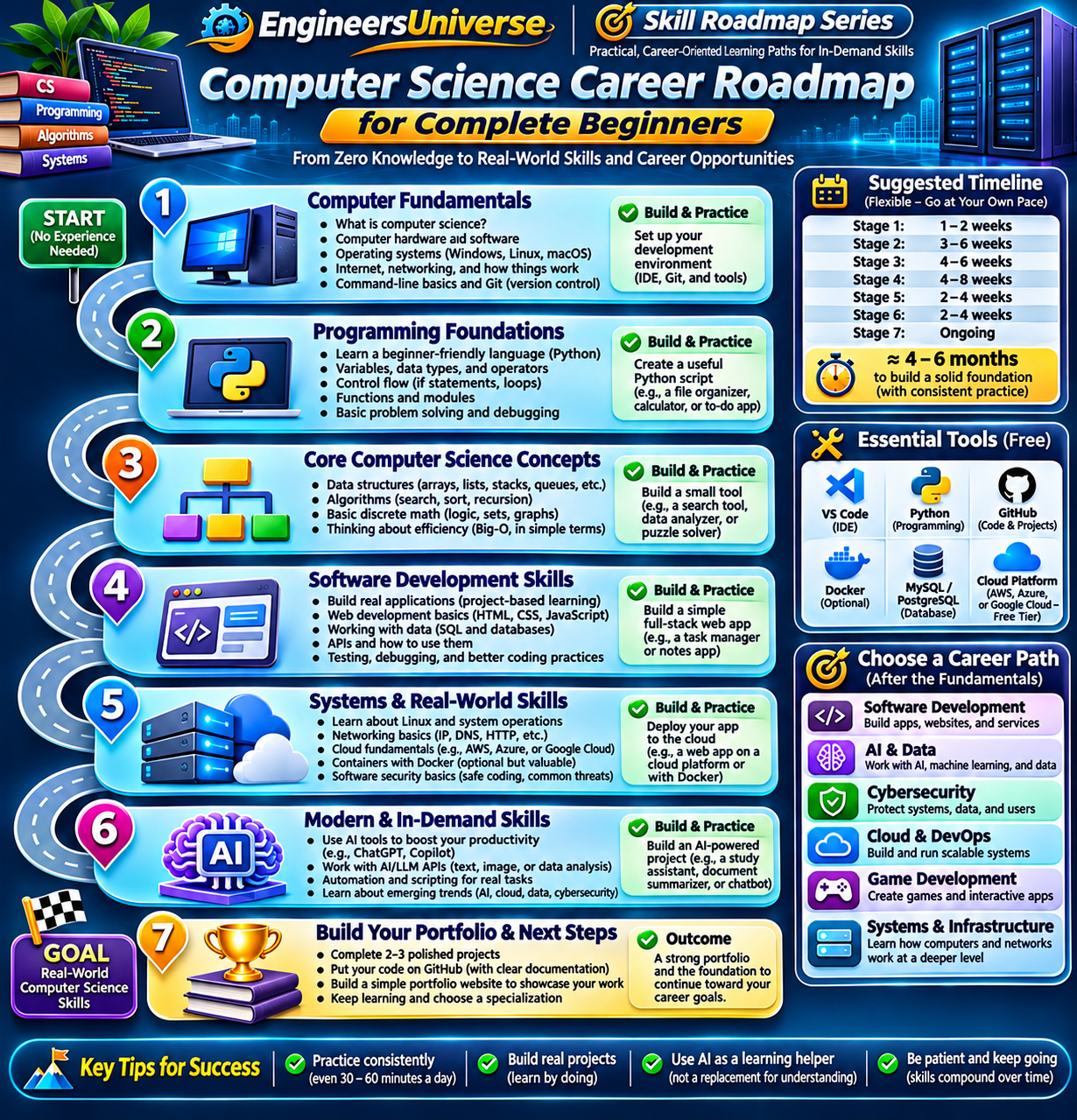
Computer Science Career Roadmap — seven-stage learning path. Read every stage in the companion guide below.
100%

Scroll to explore. Zoom is relative to the viewer width. Press Escape to close.

Computer Science Career Roadmap — original illustrated roadmap; a complete text guide follows on this page.
Download original PNG

How to use this roadmap

Read the illustration for the big picture, then work through the stage guide below. Each stage gives you a practical task and a “Ready to move on?” checkpoint. Save the project, tests and notes as evidence of your progress.

Build a foundation at your own pace

The poster suggests roughly 4–6 months, but its first six stage ranges add up to 15–30 weeks before ongoing portfolio work. These are planning prompts, not a fixed completion schedule or a job-readiness promise.

The original supplied poster is preserved as provided. The companion text clarifies timing and practice boundaries. You can repeat or extend any stage.

Jump to a stage

  1. 1. Computer fundamentals
  2. 2. Programming foundations
  3. 3. Core computer science concepts
  4. 4. Software development skills
  5. 5. Systems and real-world skills
  6. 6. Modern tools and responsible AI use
  7. 7. Portfolio and next steps

Full roadmap and explanation: free. Linked resources below show whether they include paid activities.

1. Computer fundamentals

1–2 weeks suggested · Adjust to your starting point

Learn & understand

  • Identify the roles of processor, memory, storage and operating system.
  • Practise files, folders, software installation and basic terminal commands.
  • Understand how a browser, network and server work together; begin version control.

Build & practise

Create a project folder, run a small script from a terminal and record the setup steps in a README.

Ready to move on?

Explain where your code runs, locate its files, and commit a change you can recover with Git.

2. Programming foundations

3–6 weeks suggested · Adjust to your starting point

Learn & understand

  • Use variables, data types, conditions, loops and functions.
  • Read errors and debug one small change at a time.
  • Organize code into modules and validate inputs.

Build & practise

Build a file organizer, calculator or to-do script. Start with a safe test folder and handle invalid inputs.

Ready to move on?

Run at least three normal and three invalid examples; explain why each result is correct.

3. Core computer science concepts

4–6 weeks suggested · Adjust to your starting point

Learn & understand

  • Choose between arrays/lists, dictionaries, sets, stacks and queues.
  • Compare searching, sorting and basic recursion.
  • Use simple logic and Big-O reasoning to discuss time and memory.

Build & practise

Build a search or data-analysis tool and compare two approaches on small and larger inputs.

Ready to move on?

Explain your data-structure choice and one performance trade-off using measurements.

4. Software development skills

4–8 weeks suggested · Adjust to your starting point

Learn & understand

  • Learn the roles of HTML, CSS and JavaScript in a web interface.
  • Use SQL and an API to read and write structured data.
  • Test behavior, handle errors and keep secrets out of source control.

Build & practise

Build a small task manager with a clear interface, persistent storage and documented setup.

Ready to move on?

Demonstrate creating, editing and deleting a test record and show tests for failed requests.

5. Systems and real-world skills

2–4 weeks suggested · Adjust to your starting point

Learn & understand

  • Practise Linux processes, permissions and basic service operation.
  • Trace DNS, HTTP and the path of a request.
  • Learn deployment concepts; add containers only when useful.

Build & practise

Run your project locally, then rehearse a deployment using a simulator or a clearly budgeted practice environment.

Ready to move on?

Draw the request path, locate a failure in logs and explain how you would roll back a broken change.

6. Modern tools and responsible AI use

2–4 weeks suggested · Adjust to your starting point

Learn & understand

  • Use AI assistance to explain or review code while checking its output.
  • Explore APIs and automation for a real task.
  • Protect credentials and personal data; understand tool costs before enabling a service.

Build & practise

Build a small assistant or automation with a non-AI fallback and documented limitations.

Ready to move on?

Explain the code yourself, test incorrect AI output and document what information leaves your device.

7. Portfolio and next steps

Ongoing · Adjust to your starting point

Learn & understand

  • Polish two or three projects rather than collecting unfinished tutorials.
  • Document the problem, design, tests and limitations.
  • Choose a specialization based on work you enjoyed and skills you can demonstrate.

Build & practise

Publish a portfolio README with screenshots, reproducible setup and a short reflection for each project.

Ready to move on?

A new reader can run a project, understand your contribution and see evidence of testing.

Tools & career directions

Start with what you need

  • A computer and a code editor
  • Python and a terminal
  • Git and a project repository
  • SQL database for data projects
  • Optional later: containers and a cloud platform

Tool names describe learning options, not required purchases. Availability and pricing can change; review a provider’s current terms before signing up.

Explore after the foundations

  • Software development
  • AI and data
  • Cybersecurity
  • Cloud and DevOps
  • Game development
  • Systems and infrastructure

Career entry requirements vary. A roadmap complements practice, education and experience; it does not award a qualification.

Continue learning on EngineersUniverse

Keep a portfolio record

For each project, record the problem, your approach, test results, limitations and one improvement you would make next. Remove credentials, private data and material you do not have permission to share.

Turn your projects into resume evidence →

More career & skill roadmaps

Browse the roadmap collection →