Chemical & Process Engineering System Architecture
From opportunity screening to lifecycle sustainability — the full 10-stage plant lifecycle (process concept, design & simulation, safety & risk assessment, basic and detailed engineering, construction, commissioning, and operation), the seven core engineering disciplines (material & energy balances, thermodynamics, fluid mechanics, reaction engineering, separations, process control, and process safety/HAZOP), and the process-flow & unit-operations architecture that turns raw materials into fuels, chemicals, medicines, and food. Hover, tap, or focus any component or flow for its description and code reference.
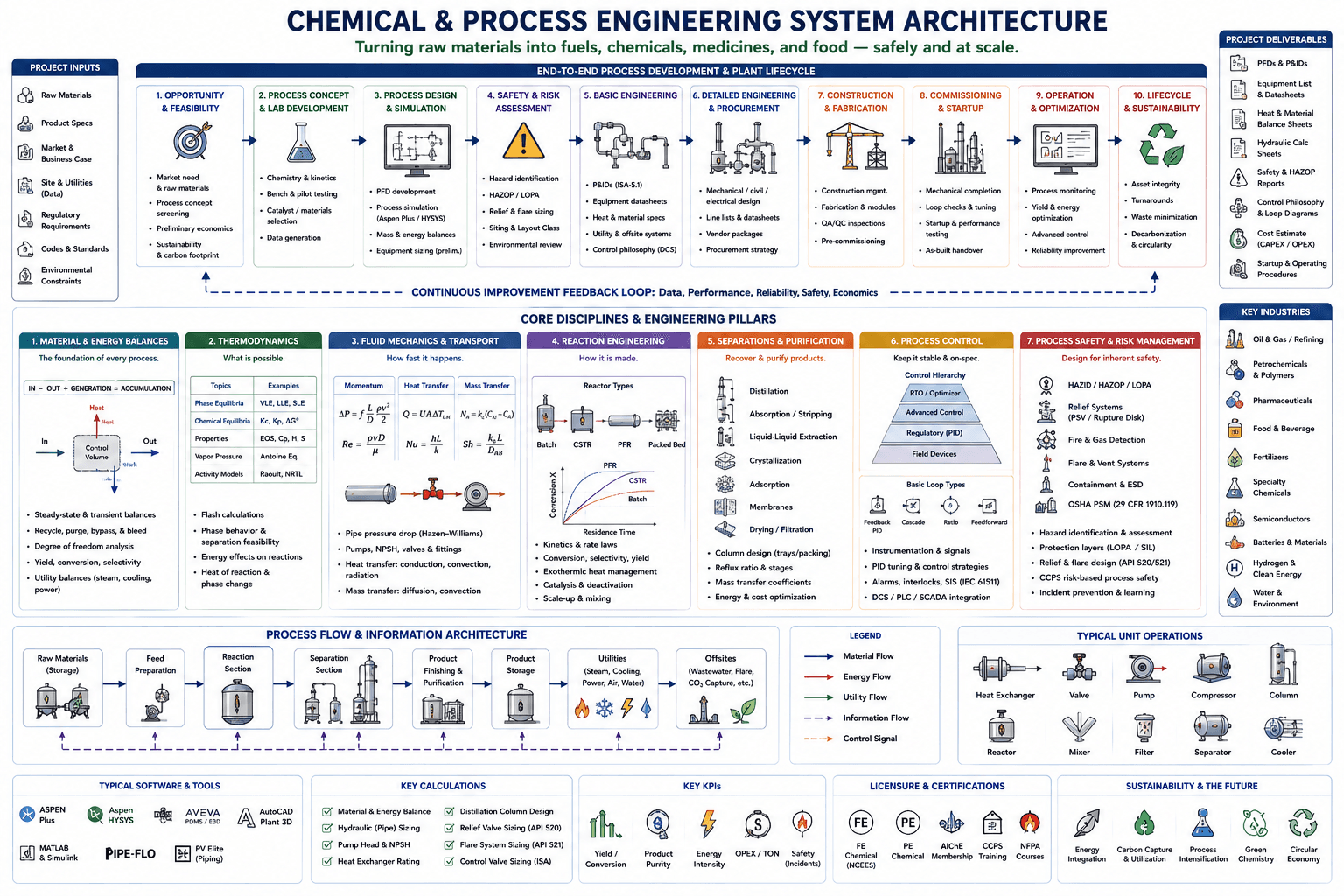
Hover, tap, or focus any component on the drawing (or a circuit below it) for details. Click to pin; move away or click again to clear.
Component Reference
Every component in the diagram above, grouped by section, with its role and the relevant standard.
Project Inputs
Raw Materials
The feedstocks, reagents, and utilities available to the process — composition, purity, supply reliability, and cost. Raw-material properties set the boundary conditions for every downstream material and energy balance.
Product Specs
The target product's purity, physical properties, and quality specifications the plant must hit consistently. Product specs drive separation and purification design and the acceptance criteria for QA/QC.
Market & Business Case
Demand forecast, pricing, and the economic case that justifies the project — the commercial driver behind capacity, plant location, and the capital the project can spend.
Site & Utilities (Data)
Site conditions and available utilities — steam, cooling water, power, compressed air, and land/soil data. Constrains equipment siting, utility balances, and the basic engineering package.
Regulatory Requirements
Environmental permits, OSHA process safety rules, and other regulatory obligations the design must satisfy from day one — not bolted on after detailed engineering.
📘 OSHA PSM 29 CFR 1910.119Codes & Standards
The engineering codes and standards that govern design — ASME pressure vessel and piping codes, API recommended practices, ISA instrumentation standards, and IEC functional-safety standards.
Environmental Constraints
Emissions limits, discharge permits, and environmental-impact constraints on the site and process. Shapes offsite treatment systems and the sustainability commitments carried through the whole lifecycle.
Project Deliverables
PFDs & P&IDs
Process Flow Diagrams show the overall process scheme and mass/energy flows; Piping & Instrumentation Diagrams add every line, valve, and instrument per ISA-5.1 symbology — the master reference for construction and operations.
📘 ISA-5.1Equipment List & Datasheets
The master equipment list plus a data sheet per vessel, pump, exchanger, and column — design conditions, materials of construction, and performance requirements for procurement and vendor bids.
Heat & Material Balance Sheets
Stream-by-stream flow, composition, temperature, pressure, and enthalpy tables generated from the process simulation — the quantitative backbone every other deliverable is checked against.
Hydraulic Calc Sheets
Line sizing, pressure-drop, and pump/compressor head calculations for every piping run — sets pipe diameters, pump specifications, and confirms the process can actually move at the design flow rate.
Safety & HAZOP Reports
Hazard and Operability study worksheets, LOPA results, and the safety design basis — documented evidence that deviations were systematically identified and mitigated before construction.
📘 CCPS / OSHA PSMControl Philosophy & Loop Diagrams
The narrative control philosophy plus individual loop diagrams for every control loop — defines how the DCS/PLC will actually run and protect the plant.
📘 ISA-5.1Cost Estimate (CAPEX/OPEX)
Capital cost estimate for equipment, installation, and indirects, plus projected operating cost — the economic deliverable that supports the investment decision at each project gate.
Startup & Operating Procedures
Step-by-step startup, normal operating, shutdown, and emergency procedures handed to the operations team — turns the engineered design into a plant operators can actually run safely.
Process Development & Plant Lifecycle
1. Opportunity & Feasibility
Screens the market need and available raw materials, does preliminary economics, and checks sustainability/carbon footprint before committing engineering budget. Kills weak projects cheaply.
2. Process Concept & Lab Development
Bench and pilot testing establishes reaction chemistry and kinetics, screens catalysts and materials, and generates the lab data the process design will be built on.
3. Process Design & Simulation
Develops the PFD, runs mass and energy balances in a process simulator (Aspen Plus / HYSYS), and does preliminary equipment sizing — the technical core of the design.
4. Safety & Risk Assessment
Formal hazard identification, HAZOP/LOPA studies, relief and flare sizing, and a siting/layout classification review — safety is designed in, not inspected in afterward.
5. Basic Engineering
Produces the first-issue P&IDs per ISA-5.1, equipment datasheets, heat & material specs, utility/offsite systems, and the DCS control philosophy — the technical package that detailed engineering is built from.
📘 ISA-5.16. Detailed Engineering & Procurement
Mechanical, civil, and electrical design, line lists and datasheets, vendor packages, and the procurement strategy — the plant is now fully specified for fabrication and construction.
7. Construction & Fabrication
Construction management, module fabrication, QA/QC inspections, and pre-commissioning — physically building what was engineered and verifying it was built to spec.
8. Commissioning & Startup
Mechanical completion, control-loop checks and tuning, startup and performance testing, and as-built handover — proving the plant meets its design performance before handover to operations.
9. Operation & Optimization
Ongoing process monitoring, yield and energy optimization, advanced process control, and reliability improvement — the longest phase of the lifecycle, where the plant earns its return.
10. Lifecycle & Sustainability
Asset integrity management, turnarounds, waste minimization, and decarbonization/circularity initiatives that extend plant life and reduce its environmental footprint.
Continuous Improvement Feedback Loop
Data, performance, reliability, safety, and economics feedback flows from operation back into every earlier lifecycle stage — the loop that turns each plant's operating history into better design decisions on the next project or turnaround.
Material & Energy Balances
Material & Energy Balances — Concept
The generalized balance IN − OUT + GENERATION = ACCUMULATION applied to a control volume, with mass, heat, and work crossing its boundary. The foundation every other process calculation is built on.
Material & Energy Balances — Key Topics
Steady-state and transient balances, recycle/purge/bypass/bleed streams, degree-of-freedom analysis, yield/conversion/selectivity, and utility balances for steam, cooling, and power.
Thermodynamics
Thermodynamics — Concept (Topics & Examples)
What phase and chemical equilibrium is possible: phase equilibria (VLE/LLE/SLE), chemical equilibria (Kc, Kp, ΔG°), properties from equations of state (Cp, H, S), vapor pressure via the Antoine equation, and activity models (Raoult's law, NRTL).
Thermodynamics — Key Topics
Flash calculations, phase behavior and separation feasibility, energy effects on reactions, and heat of reaction / phase change — the thermodynamic limits that bound what the process can achieve.
Fluid Mechanics & Transport
Fluid Mechanics — Momentum Transport
Momentum transport: Darcy-Weisbach pressure drop ΔP = f(L/D)(ρv²/2) and the Reynolds number Re = ρvD/μ that sets the friction factor and flow regime (laminar vs. turbulent).
Fluid Mechanics — Heat Transfer
Convective heat transfer: Q = UAΔT_lm sizes exchanger duty from the overall coefficient and log-mean temperature difference; the Nusselt number Nu = hL/k relates the film coefficient to conduction.
Fluid Mechanics — Mass Transfer
Interphase mass transfer: flux N_A = k_c(C_Ai − C_A) driven by a concentration difference, with the Sherwood number Sh = k_cL/D_AB relating the mass-transfer coefficient to diffusion.
Fluid Mechanics — Pipe, Valve & Pump Flow Train
The physical flow train that momentum-transport theory sizes — straight pipe run, control valve, and centrifugal pump — the equipment every hydraulic calc sheet is built around.
Fluid Mechanics & Transport — Key Topics
Pipe pressure drop (Hazen-Williams), pumps/NPSH/valves & fittings, heat transfer by conduction/convection/radiation, and mass transfer by diffusion and convection.
Reaction Engineering
Reaction Engineering — Reactor Types
The four workhorse reactor configurations — Batch, CSTR (continuous stirred-tank), PFR (plug-flow), and Packed Bed — each with different mixing patterns and residence-time distributions.
Reaction Engineering — Conversion vs. Residence Time
Conversion X climbs fastest with residence time in a PFR, then CSTR, then Batch, for the same first-order kinetics — the classic curve explaining why a PFR is almost always the smallest reactor for a given duty.
Reaction Engineering — Key Topics
Kinetics and rate laws, conversion/selectivity/yield, exothermic heat management, catalysis and deactivation, and scale-up and mixing — turning bench chemistry into a commercial reactor.
Separations & Purification
Separations & Purification — Unit Operations
The core separation toolkit: distillation, absorption/stripping, liquid-liquid extraction, crystallization, adsorption, membranes, and drying/filtration — each exploits a different property difference to recover and purify product.
Separations & Purification — Key Topics
Column design (trays vs. packing), reflux ratio and theoretical stages, mass-transfer coefficients, and energy/cost optimization — the design decisions that set separation capital and operating cost.
Process Control
Process Control — Control Hierarchy
The classic automation pyramid: Field Devices at the base, then Regulatory (PID) control, Advanced Control, and RTO/Optimizer at the top — each layer sets targets for the layer below it.
📘 ISA-95Process Control — Basic Loop Types
The four basic control-loop architectures: Feedback (PID), Cascade (inner/outer loop), Ratio (fixed proportion between two variables), and Feedforward (disturbance-based, anticipatory correction).
Process Control — Key Topics
Instrumentation and signals, PID tuning and control strategies, alarms/interlocks/Safety Instrumented Systems, and DCS/PLC/SCADA integration that ties the control layer to the plant floor.
📘 IEC 61511Process Safety & Risk Management
Process Safety — Key Systems
The physical and procedural safety layers: HAZID/HAZOP/LOPA hazard studies, relief systems (PSV/rupture disk), fire & gas detection, flare & vent systems, containment & emergency shutdown (ESD), and the OSHA Process Safety Management program.
📘 OSHA PSM 29 CFR 1910.119Process Safety — Key Topics
Hazard identification and assessment, layers of protection (LOPA/SIL), relief and flare design per API 520/521, CCPS risk-based process safety, and incident prevention and learning.
📘 API 520 / API 521Key Industries
Oil & Gas / Refining
Crude distillation, catalytic cracking, and fuels production — one of the largest employers of process engineers and the origin of much of modern process design practice.
Petrochemicals & Polymers
Cracking and polymerization convert oil & gas feedstocks into monomers and plastics — heavy on reaction engineering, high-pressure separations, and exothermic reactor safety.
Pharmaceuticals
Batch and continuous synthesis, crystallization, and purification under strict cGMP quality control — small volumes, high purity, and heavy validation and documentation requirements.
Food & Beverage
Fermentation, pasteurization, evaporation, and packaging under food-safety regulation — process engineering applied to products consumed directly by people.
Fertilizers
Ammonia synthesis, urea, and phosphate processing at massive scale — energy-intensive reaction engineering feeding global agriculture.
Specialty Chemicals
Lower-volume, higher-value chemicals — coatings, adhesives, catalysts, additives — where batch flexibility and formulation science matter as much as unit operations.
Semiconductors
Ultra-high-purity gases, chemicals, and water for chip fabrication — process engineering at parts-per-trillion contamination control.
Batteries & Materials
Cathode/anode material synthesis, electrolyte production, and cell assembly — a fast-growing process-engineering frontier tied to the energy transition.
Hydrogen & Clean Energy
Electrolysis, steam methane reforming, and carbon capture — process engineering central to decarbonizing industry and transportation.
Water & Environment
Water treatment, wastewater processing, and environmental remediation — separations and reaction engineering applied to protecting water resources.
Process Flow & Unit Operations
Raw Materials (Storage)
Incoming feedstock tankage and warehousing — the first stage of the physical value stream, sized and permitted per the raw-materials data captured in Project Inputs.
Feed Preparation
Pumping, metering, filtering, and conditioning raw feed to the temperature, pressure, and composition the reaction section needs.
Reaction Section
The reactor (batch, CSTR, PFR, or packed bed) where the core chemical transformation happens — the heart of the process, sized by the Reaction Engineering discipline.
Separation Section
Distillation, extraction, or other separation trains that split the reactor effluent into product, byproducts, and recycle streams.
Product Finishing & Purification
Final polishing steps — crystallization, drying, or additional purification — that bring the product to its final sellable specification.
Product Storage
Finished-product tankage awaiting shipment, sized against the demand and logistics captured in the project's market and business case.
Utilities (Steam, Cooling, Power, Air, Water)
Steam, cooling water, electrical power, compressed air, and process water that every other block in the chain depends on — the plant's life-support system.
Offsites (Wastewater, Flare, CO₂ Capture, etc.)
Wastewater treatment, flare systems, and increasingly CO₂ capture — the environmental and safety systems that handle everything the core process doesn't sell as product.
Information-Flow Feedback Loop
The dashed information-flow path returning measurements and status from every stage of the block-flow diagram back upstream — the data backbone that feeds the historian, MES/DCS, and continuous-improvement loop.
Heat Exchanger
Transfers heat between two process streams without mixing them — shell-and-tube and plate designs are the workhorses of process heat recovery.
Valve
Throttles or isolates flow — control valves modulate flow continuously while block valves provide on/off isolation for maintenance and safety.
Pump
Adds mechanical energy to move liquid through the process — centrifugal pumps are sized against system head and checked for cavitation via NPSH.
Compressor
Raises the pressure of a gas stream — centrifugal or reciprocating, sized against compression ratio, flow, and gas properties.
Column
A distillation, absorption, or stripping column with trays or packing — the primary vapor-liquid separation device in most chemical processes.
Reactor
The vessel where the chemical reaction takes place — stirred tank, tubular, or packed-bed, sized by kinetics and heat-management requirements.
Mixer
Blends two or more streams or agitates a vessel's contents to achieve composition or temperature uniformity before the next process step.
Filter
Removes solid particles from a liquid or gas stream — a key polishing step before storage or a downstream sensitive unit operation.
Separator
A vessel that splits a mixed-phase stream into its vapor and liquid (and sometimes second-liquid) components by gravity settling.
Cooler
Removes heat from a process stream to bring it to the temperature required by storage or the next process step.
Software, Calculations & KPIs
Aspen Plus
The industry-standard steady-state process simulator for rigorous mass/energy balances, thermodynamics, and equipment sizing.
Aspen HYSYS
A process simulator favored in oil & gas and refining, strong in dynamic simulation and upstream/midstream applications.
AVEVA PDMS / E3D
3D plant design software for piping, structural, and equipment layout — produces the model that isometrics and construction drawings are extracted from.
AutoCAD Plant 3D
AutoCAD's plant-design toolset for P&ID creation and 3D piping design, widely used alongside or instead of AVEVA on smaller projects.
MATLAB & Simulink
Numerical computing and dynamic-simulation environment used for control-loop tuning studies, custom process models, and data analysis.
PIPE-FLO
Specialized hydraulic modeling software for pipe networks and pump-system design — solves complex piping systems that hand calculations can't.
PV Elite (Piping)
Pressure-vessel and piping mechanical-design software used to verify vessels and piping against ASME code stress and thickness requirements.
Material & Energy Balance
The steady-state IN − OUT + GENERATION = ACCUMULATION calculation applied to every stream and unit in the process.
Hydraulic (Pipe) Sizing
Sizing pipe diameter against allowable velocity and pressure-drop limits using the Darcy-Weisbach equation.
Pump Head & NPSH
Total dynamic head and Net Positive Suction Head calculations that size the pump and confirm it won't cavitate.
Heat Exchanger Rating
Confirms a proposed exchanger's area and configuration deliver the required duty via Q = UAΔT_lm.
Distillation Column Design
Theoretical-stage and reflux-ratio calculations (McCabe-Thiele or rigorous simulation) that size a distillation column.
Relief Valve Sizing (API 520)
Sizes pressure-relief valves for overpressure scenarios per API 520 methodology — a life-safety calculation.
📘 API 520Flare System Sizing (API 521)
Sizes flare headers and tips to safely relieve and combust process upsets per API 521 guidance on pressure-relieving systems.
📘 API 521Control Valve Sizing (ISA)
Sizes a control valve's Cv against the required flow and pressure-drop authority per ISA valve-sizing standards.
📘 ISA-75Yield / Conversion
The fraction of feed converted to desired product — the single biggest lever on raw-material cost and plant profitability.
Product Purity
How closely the product meets its purity specification — directly tied to separation-train design and customer acceptance.
Energy Intensity
Energy consumed per unit of product — the KPI that ties process efficiency directly to operating cost and carbon footprint.
OPEX / TON
Operating cost per ton of product — the roll-up economic KPI that operations is ultimately measured against.
Safety (Incidents)
Recordable safety incidents and near-misses — the leading indicator that the process safety program is actually working.
Licensure & Sustainability
FE Chemical (NCEES)
The Fundamentals of Engineering exam in the Chemical discipline — the first licensure milestone, typically taken senior year or shortly after graduation.
PE Chemical
The Professional Engineer license in Chemical Engineering — required to stamp drawings and take legal responsibility for engineering work in most jurisdictions.
AIChE Membership
The American Institute of Chemical Engineers — the discipline's professional society, offering technical resources, networking, and continuing education.
CCPS Training
Center for Chemical Process Safety training and certification — the industry-standard body of knowledge for process safety practice.
NFPA Courses
National Fire Protection Association training relevant to flammable/combustible process hazards, fire protection, and hazardous-area classification.
Energy Integration
Pinch analysis and heat integration that recover waste heat between hot and cold process streams, cutting utility consumption and cost.
Carbon Capture & Utilization
Capturing CO₂ from process or flue gas streams and either sequestering it or converting it into usable products — central to decarbonizing chemical plants.
Process Intensification
Combining multiple unit operations into fewer, smaller, more efficient equipment items — reactive distillation and microreactors are classic examples.
Green Chemistry
Designing reactions and processes to reduce or eliminate hazardous substances at the source, following the twelve principles of green chemistry.
Circular Economy
Designing processes around recycling, reuse, and waste-as-feedstock rather than a linear take-make-dispose model.
Connections & Flows
The material, energy, utility, information, and control flow types that tie the diagram together — each shown as a colored line in the legend above.
Material Flow
The physical movement of process material — feed, intermediates, and product — through the block-flow diagram from raw-materials storage to product storage.
📘 ISA-5.1Energy Flow
Heat and work crossing a control volume or moving between process units — steam, fired heat, and mechanical work that the energy balance tracks alongside mass.
Utility Flow
Steam, cooling water, power, compressed air, and process water supplied from the Utilities block to every stage of the process that needs them.
Information Flow
Measurements, status, and performance data flowing back from the process to instrumentation, the historian, and the continuous-improvement feedback loop.
📘 ISA-95Control Signal
Setpoints and control-output signals sent from the control system down to final control elements — valves, pumps, and other actuators.
📘 ISA-5.1