Environmental & Water Resources Engineering System Architecture
Protecting public health and the environment by managing how water moves, is treated, and is returned to nature — the full 9-stage water & environmental system life cycle (planning & assessment, data collection & modeling, design & engineering, permitting & compliance, procurement & construction, operation & maintenance, monitoring & performance, renewal & improvement, and resource recovery & circularity), the eight core disciplines from hydrology and hydraulics through drinking water and wastewater treatment to groundwater and air quality/solid waste, and the integrated potable, wastewater, and stormwater system view from watershed to receiving water. Hover, tap, or focus any component or flow for its description and code reference.
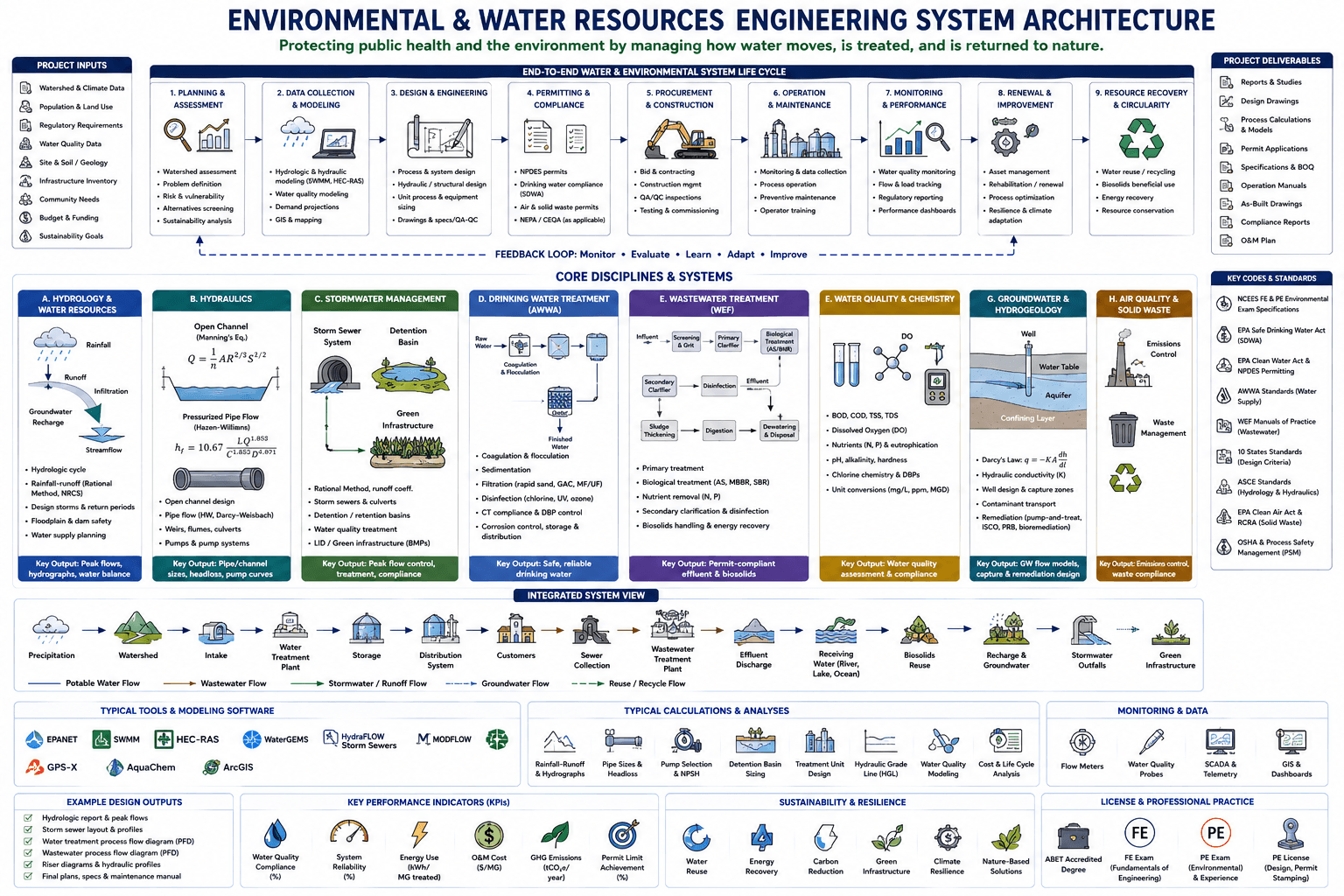
Hover, tap, or focus any component on the drawing (or a circuit below it) for details. Click to pin; move away or click again to clear.
Component Reference
Every component in the diagram above, grouped by section, with its role and the relevant standard.
Project Inputs
Watershed & Climate Data
Precipitation records, drainage-area delineation, and climate/rainfall-intensity data that seed every hydrologic and hydraulic calculation downstream — from the Rational Method to design-storm selection.
Population & Land Use
Current and projected population, land-use mix, and zoning that drive water-demand forecasts, wastewater flow projections, and impervious-cover assumptions for stormwater design.
Regulatory Requirements
The federal, state, and local regulatory framework — Safe Drinking Water Act, Clean Water Act/NPDES, and local design ordinances — that sets the compliance targets every downstream deliverable must satisfy.
📘 EPA SDWA / Clean Water ActWater Quality Data
Existing source-water, effluent, and receiving-water quality sampling — the baseline that treatment-process selection and NPDES permit limits are measured against.
Site & Soil / Geology
Soil borings, infiltration rates, and subsurface geology that govern foundation design, green-infrastructure feasibility, and groundwater flow modeling.
Infrastructure Inventory
GIS records and condition assessments of existing pipes, pump stations, and treatment assets — the starting point for capacity analysis, rehabilitation planning, and asset management.
Community Needs
Community priorities, public-health concerns, and affordability constraints gathered through stakeholder engagement, weighed alongside technical criteria in alternatives screening.
Budget & Funding
Available capital budget, state revolving fund loans, and grant programs that bound the feasible design alternatives and the pace of capital improvement.
Sustainability Goals
Utility or municipal sustainability targets — water reuse, energy recovery, carbon reduction, and climate resilience — that increasingly shape alternative selection alongside cost and compliance.
Project Deliverables
Reports & Studies
Watershed assessments, feasibility studies, and planning reports that document the problem definition, alternatives analysis, and recommended path forward.
Design Drawings
The engineering drawing set — plans, profiles, sections, and details — that translates the selected design into buildable construction documents.
Process Calculations & Models
The supporting engineering calculations and models (hydraulic, hydrologic, water-quality, treatment-process) that justify sizing decisions throughout the design.
Permit Applications
The regulatory permit applications — NPDES discharge, drinking-water compliance, and air/solid-waste permits — submitted to the governing agencies before construction.
📘 EPA Clean Water Act & NPDESSpecifications & BOQ
Technical specifications and the bill of quantities that accompany the drawings into competitive bidding and construction contracting.
Operation Manuals
Operating procedures, control narratives, and equipment manuals handed to plant staff so the completed facility runs the way it was designed to.
As-Built Drawings
Record drawings reflecting what was actually constructed, reconciling field changes with the original design set for future reference and GIS updates.
Compliance Reports
Discharge monitoring reports and other recurring regulatory submittals that demonstrate ongoing compliance with permit limits after commissioning.
O&M Plan
The formal operation-and-maintenance plan — preventive maintenance schedules, staffing, and asset-renewal strategy — that carries the facility through its service life.
Key Codes & Standards
NCEES FE & PE Environmental Exam Specifications
The NCEES exam specifications that define what the FE and PE Environmental exams test — the roadmap for exam prep and a proxy for the discipline’s core body of knowledge.
📘 NCEES FE / PE EnvironmentalEPA Safe Drinking Water Act (SDWA)
The federal law governing public drinking-water systems — maximum contaminant levels, treatment technique requirements, and monitoring that drinking-water treatment design must satisfy.
📘 EPA Safe Drinking Water ActEPA Clean Water Act & NPDES Permitting
The federal law governing discharges to surface water, implemented through NPDES permits that set effluent limits for wastewater treatment plants and stormwater outfalls alike.
📘 EPA Clean Water Act / NPDESAWWA Standards (Water Supply)
American Water Works Association standards covering pipe materials, treatment-plant design, and operational practice across the drinking-water supply industry.
📘 AWWA StandardsWEF Manuals of Practice (Wastewater)
Water Environment Federation Manuals of Practice — the standard reference for wastewater collection, treatment, and biosolids management design practice.
📘 WEF Manuals of Practice10 States Standards (Design Criteria)
The "Recommended Standards for Water Works / Wastewater Facilities" — widely adopted regional design criteria for treatment plant and collection/distribution system sizing.
📘 10 States StandardsASCE Standards (Hydrology & Hydraulics)
American Society of Civil Engineers standards and manuals of practice covering hydrology, open-channel and pipe hydraulics, and stormwater system design.
📘 ASCE StandardsEPA Clean Air Act & RCRA (Solid Waste)
Federal statutes governing air emissions (Clean Air Act) and solid/hazardous-waste management (RCRA) that apply to treatment-plant emissions, biosolids disposal, and residuals handling.
📘 EPA Clean Air Act / RCRAOSHA & Process Safety Management (PSM)
OSHA occupational safety regulations and Process Safety Management requirements for facilities handling hazardous chemicals such as chlorine gas and ozone.
📘 OSHA PSM (29 CFR 1910.119)Water & Environmental System Life Cycle
1. Planning & Assessment
The lifecycle opens with watershed assessment, problem definition, risk & vulnerability screening, alternatives screening, and a first-pass sustainability analysis that frames everything downstream.
2. Data Collection & Modeling
Field data collection feeds hydrologic and hydraulic modeling (SWMM, HEC-RAS), water-quality modeling, demand projections, and GIS mapping that quantify the problem before design begins.
3. Design & Engineering
Process and system design, hydraulic/structural design, unit process and equipment sizing, and the drawings/specs/QA-QC that turn the concept into an engineered solution.
4. Permitting & Compliance
NPDES permits, drinking-water compliance (SDWA) review, air and solid-waste permits, and NEPA/CEQA environmental review as applicable — the regulatory gate before construction.
📘 EPA SDWA / NPDES / NEPA5. Procurement & Construction
Bid and contracting, construction management, QA/QC inspections, and testing & commissioning that turn approved drawings into a physical, working facility.
6. Operation & Maintenance
Monitoring and data collection, day-to-day process operation, preventive maintenance, and operator training that keep the commissioned facility running to design intent.
7. Monitoring & Performance
Ongoing water-quality monitoring, flow and load tracking, regulatory reporting, and performance dashboards that verify the system continues to meet permit and design targets.
8. Renewal & Improvement
Asset management, rehabilitation and renewal, process optimization, and resilience/climate adaptation planning that extend and improve the system over its service life.
9. Resource Recovery & Circularity
Water reuse and recycling, biosolids beneficial use, energy recovery, and resource conservation — closing the loop from the traditional linear treat-and-discharge model toward circularity.
Feedback Loop: Monitor · Evaluate · Learn · Adapt · Improve
Performance data from monitoring and operation feeds back to re-evaluate planning assumptions and design decisions — the continuous-improvement loop that makes the lifecycle iterative rather than one-directional.
Hydrology & Water Resources
Hydrologic Cycle: Rainfall, Runoff, Infiltration & Streamflow
The hydrologic cycle diagram: rainfall partitions into surface runoff and infiltration, infiltration recharges groundwater, and both pathways ultimately feed streamflow — the physical basis for every rainfall-runoff calculation.
Hydrology Design Topics
Core hydrology practice: the hydrologic cycle, rainfall-runoff methods (Rational Method, NRCS curve number), design storms and return periods, floodplain and dam safety, and long-range water-supply planning. Key output: peak flows, hydrographs, and water balance.
📘 ASCE Standards (Hydrology & Hydraulics)Hydraulics
Open-Channel Flow (Manning’s Equation)
Manning’s equation relates open-channel discharge to channel roughness, cross-sectional area, hydraulic radius, and slope — the workhorse formula for sizing storm sewers, culverts, and drainage channels.
📘 Manning's EquationPressurized Pipe Flow (Hazen-Williams)
The Hazen-Williams equation computes friction head loss in a pressurized water pipe from length, flow, the pipe’s C-factor, and diameter — the standard sizing check for distribution mains and force mains.
📘 Hazen-Williams EquationHydraulics Design Topics
Open-channel design, pipe flow (Hazen-Williams and Darcy-Weisbach), weirs/flumes/culverts, and pumps & pump systems. Key output: pipe/channel sizes, head loss, and pump curves.
Stormwater Management
Storm Sewer System
The piped storm-drain network that collects and conveys stormwater runoff from streets and developed areas to outfalls, detention facilities, or receiving waters.
Detention Basin
A detention or retention basin that temporarily stores stormwater runoff and releases it at a controlled rate, limiting peak downstream flow to the allowable release rate.
Green Infrastructure / LID
Low-impact development and green infrastructure — bioswales, rain gardens, and permeable systems — that manage stormwater at the source through infiltration and evapotranspiration rather than piped conveyance alone.
Stormwater Design Topics
Rational Method and runoff coefficients, storm sewers and culverts, detention/retention basin design, water-quality treatment, and LID/green-infrastructure BMPs. Key output: peak flow control, treatment, and compliance.
Drinking Water Treatment (AWWA)
Drinking Water Treatment Train
The conventional drinking-water treatment train: raw water intake, coagulation & flocculation to clump fine particles, clarification/sedimentation, filtration, and final disinfection before the water reaches finished-water storage.
📘 AWWA Standards (Water Supply)Drinking Water Design Topics
Coagulation & flocculation, sedimentation, filtration (rapid sand, GAC, MF/UF), disinfection (chlorine, UV, ozone), CT compliance & disinfection byproduct control, and corrosion control/storage/distribution. Key output: safe, reliable drinking water.
📘 EPA Safe Drinking Water ActWastewater Treatment (WEF)
Wastewater Liquid Treatment Train
The liquid-stream treatment train: influent screening & grit removal, primary clarification, biological treatment (activated sludge/MBBR), secondary clarification, and disinfection before effluent discharge.
📘 WEF Manuals of PracticeBiosolids / Sludge Handling Train
The solids-stream process: sludge thickening, anaerobic/aerobic digestion, and dewatering & disposal that stabilize and reduce the volume of biosolids generated by the liquid treatment train.
Wastewater Design Topics
Primary treatment, biological treatment (AS, MBBR, SBR), nutrient removal (N, P), secondary clarification & disinfection, and biosolids handling & energy recovery. Key output: permit-compliant effluent & biosolids.
📘 EPA Clean Water Act & NPDESWater Quality & Chemistry
Water Quality Sampling & Analysis
Laboratory sampling (BOD/DO test bottles), water chemistry, and field meters/probes that quantify water quality — the measurement backbone behind every treatment and compliance decision.
Water Quality Design Topics
BOD, COD, TSS, TDS; dissolved oxygen (DO); nutrients (N, P) and eutrophication; pH, alkalinity, and hardness; chlorine chemistry and disinfection byproducts; and unit conversions (mg/L, ppm, MGD). Key output: water-quality assessment & compliance.
Groundwater & Hydrogeology
Well, Water Table & Aquifer Cross-Section
A hydrogeologic cross-section showing a water-supply well penetrating the water table into a confined aquifer above a confining layer — the physical system Darcy’s Law describes.
Groundwater Design Topics
Darcy's Law (q = -KA·dh/dl), hydraulic conductivity, well design & capture zones, contaminant transport, and remediation (pump-and-treat, ISCO, PRB, bioremediation). Key output: groundwater flow models, capture & remediation design.
Air Quality & Solid Waste
Emissions Control
Air-emissions control for treatment-plant stacks and fugitive sources — odor control, digester gas handling, and combustion controls that keep facility emissions within Clean Air Act limits.
📘 EPA Clean Air ActWaste Management & Circularity
Solid-waste and residuals management, including screenings and grit disposal, alongside recycling and beneficial-reuse pathways that reduce landfill dependence. Key output: emissions control & waste compliance.
📘 EPA RCRA (Solid Waste)Integrated System View
Precipitation
The system’s ultimate water source — rain and snowfall over the watershed that becomes runoff, infiltration, and eventually the raw water supply.
Watershed
The topographic drainage area that collects precipitation and routes it toward a common outlet — the spatial unit hydrologic modeling is built around.
Intake
The raw-water intake structure — surface-water or groundwater — where water is withdrawn from the environment to begin the potable water flow.
Water Treatment Plant
The drinking-water treatment plant where raw water is coagulated, clarified, filtered, and disinfected into finished, potable water.
Storage
Finished-water storage — clearwells and elevated or ground-level tanks — that provides disinfection contact time, equalizes demand, and maintains system pressure.
Distribution System
The pressurized pipe network — mains, valves, and pump stations — that delivers finished water from storage to customers, sized using the Hazen-Williams equation.
Customers
The end users — residential, commercial, and industrial customers — whose demand drives system sizing and whose wastewater flow enters the sewer collection system.
Sewer Collection
The gravity and force-main sewer network that collects wastewater from customers and conveys it to the wastewater treatment plant.
Wastewater Treatment Plant
The wastewater treatment plant where collected sewage undergoes primary, biological, and disinfection treatment before discharge or reuse.
Effluent Discharge
The permitted outfall where treated effluent is released to a receiving water body under the facility’s NPDES discharge permit.
📘 EPA NPDES PermittingReceiving Water (River, Lake, Ocean)
The river, lake, or ocean that receives treated effluent, stormwater runoff, and groundwater discharge — the environmental endpoint the whole system is designed to protect.
Biosolids Reuse
Beneficial reuse of treated biosolids — land application as fertilizer or soil amendment — that closes the loop on the wastewater treatment plant’s solid residuals.
Recharge & Groundwater
Infiltrated stormwater and intentional aquifer-recharge projects that replenish groundwater — connecting the surface water cycle back to the subsurface system.
Stormwater Outfalls
The discharge points where the storm sewer system releases collected runoff to receiving waters, typically without treatment unless upstream BMPs are provided.
Green Infrastructure
Bioswales, rain gardens, and other nature-based systems that intercept and treat stormwater at the source before it ever reaches a pipe or outfall.
Tools, Calculations & Monitoring
EPANET
EPA’s free hydraulic and water-quality modeling software for pressurized distribution networks — the industry-standard tool for simulating pipe flow, pressure, and water age across a system.
SWMM
EPA’s Storm Water Management Model — the standard dynamic rainfall-runoff and hydraulic routing simulator for urban stormwater and combined-sewer systems.
HEC-RAS
The Army Corps of Engineers’ River Analysis System for open-channel hydraulics, floodplain mapping, and bridge/culvert hydraulic analysis.
WaterGEMS
Bentley’s GIS-integrated water distribution modeling platform, used for hydraulic analysis, fire-flow studies, and capital planning of distribution networks.
HydraFLOW Storm Sewers
Storm-sewer design software used to size pipe networks and check hydraulic grade lines for stormwater collection systems.
MODFLOW
The USGS modular groundwater flow model — the industry-standard finite-difference simulator for aquifer flow, well capture zones, and contaminant transport.
GPS-X
Dynamic wastewater treatment process simulation software used to model biological nutrient removal and optimize plant operation before capital changes are made.
AquaChem
Water-quality data management and geochemical analysis software used to interpret groundwater and surface-water chemistry results.
ArcGIS
The industry-standard GIS platform used to map watersheds, infrastructure inventories, service areas, and environmental data layers across a project.
Rainfall-Runoff & Hydrographs
Calculations that convert a design rainfall event into a runoff hydrograph — the Rational Method for small sites and NRCS unit hydrograph methods for larger watersheds.
Pipe Sizes & Headloss
Pipe-sizing and friction head-loss calculations using Hazen-Williams or Darcy-Weisbach — the core check for both water distribution mains and force mains.
Pump Selection & NPSH
Pump selection against the system head curve, with net positive suction head (NPSH) checks to avoid cavitation in water and wastewater pumping stations.
Detention Basin Sizing
Sizing the storage volume a detention or retention basin needs to attenuate peak outflow to the allowable release rate, from inflow/outflow hydrograph routing.
Treatment Unit Design
Sizing calculations for treatment unit processes — clarifiers, filters, and biological reactors — based on hydraulic and organic loading criteria.
Hydraulic Grade Line (HGL)
Hydraulic grade line calculations that trace pressure/energy along a pipe or channel profile, checking for surcharging, adequate freeboard, and pump duty points.
Water Quality Modeling
Modeling the fate and transport of water-quality constituents — dissolved oxygen sag curves, disinfectant decay, and pollutant loading — through a treatment process or receiving water.
Cost & Life Cycle Analysis
Life-cycle cost analysis comparing capital and operating costs across design alternatives — the economic lens applied alongside technical performance.
Flow Meters
Magnetic, ultrasonic, and Venturi flow meters that measure real-time flow at plant influent/effluent, distribution zones, and sewer trunk lines.
Water Quality Probes
In-situ sensors for dissolved oxygen, pH, turbidity, and chlorine residual that provide continuous water-quality data for process control and compliance.
SCADA & Telemetry
Supervisory control and data acquisition systems that give operators remote monitoring and control across distributed pump stations, tanks, and treatment processes.
GIS & Dashboards
GIS-based asset maps and performance dashboards that turn raw monitoring data into the visual, spatial picture operators and managers use daily.
Design Outputs, KPIs & Sustainability
Hydrologic Report & Peak Flows
The hydrologic report documenting design-storm assumptions, methodology, and resulting peak flows that support downstream drainage design.
Storm Sewer Layout & Profiles
Plan-and-profile drawings of the storm sewer network showing pipe sizes, slopes, and structure locations.
Water Treatment Process Flow Diagram (PFD)
The process flow diagram showing the drinking-water treatment train from raw-water intake to finished-water storage.
Wastewater Process Flow Diagram (PFD)
The process flow diagram showing the wastewater treatment train from influent through liquid and solids processing to discharge.
Riser Diagrams & Hydraulic Profiles
Riser diagrams and hydraulic profiles documenting the vertical arrangement and hydraulic grade line through treatment units and pump stations.
Final Plans, Specs & Maintenance Manual
The complete final package — construction plans, specifications, and the maintenance manual — handed off at project closeout.
Water Quality Compliance (%)
The percentage of water-quality samples meeting regulatory standards — the headline KPI for both drinking-water and effluent compliance.
System Reliability (%)
System uptime and service continuity — the share of time the treatment or distribution system operates without unplanned interruption.
Energy Use (kWh/MG treated)
Energy consumed per million gallons treated — a key operating-cost and sustainability metric that pumping and aeration dominate.
O&M Cost ($/MG)
Operations and maintenance cost normalized per million gallons treated or delivered — the standard basis for comparing plant efficiency.
GHG Emissions (tCO2e/year)
Annual greenhouse-gas emissions in tonnes of CO2-equivalent — tracked as utilities set carbon-reduction and net-zero targets.
Permit Limit Achievement (%)
The percentage of monitoring periods in which discharge or drinking-water permit limits were achieved — the regulatory bottom line.
📘 EPA NPDES / SDWAWater Reuse
Reclaimed/recycled water programs that offset potable demand for irrigation, industrial process water, and other non-potable uses.
Energy Recovery
Capturing energy from the treatment process itself — digester biogas-to-energy and in-conduit hydropower — to offset plant electrical demand.
Carbon Reduction
Process optimization, renewable energy, and efficiency measures that reduce the carbon footprint of treating and moving water.
Green Infrastructure
Nature-based stormwater management that delivers water-quality, flood-control, and habitat benefits alongside traditional gray infrastructure.
Climate Resilience
Adapting infrastructure to more intense storms, drought, and sea-level rise — building resilience into design storms, freeboard, and redundancy.
Nature-Based Solutions
Solutions that work with natural systems — wetland restoration, floodplain reconnection, and living shorelines — as an alternative or complement to hard infrastructure.
License & Professional Practice
ABET Accredited Degree
A degree from an ABET-accredited engineering program — the educational foundation required to sit for the FE exam and pursue licensure.
FE Exam (Fundamentals of Engineering)
The Fundamentals of Engineering exam — typically taken near graduation — is the first of two exams required for professional engineering licensure.
📘 NCEES FE ExamPE Exam (Environmental) & Experience
The PE Environmental exam, combined with several years of qualifying engineering experience under a licensed PE, is required before a state will grant a professional engineering license.
📘 NCEES PE Environmental ExamPE License (Design, Permit Stamping)
The licensed Professional Engineer’s stamp is the legal authority required to seal design drawings and permit applications for public water and wastewater infrastructure.
Connections & Flows
The potable, wastewater, stormwater, groundwater, and reuse flow types that tie the diagram together — each shown as a colored line in the legend above.
Potable Water Flow
The treated drinking-water pathway from intake through the treatment plant, storage, and the pressurized distribution system to customers.
📘 AWWA StandardsWastewater Flow
The sewage pathway from customers through sewer collection to the wastewater treatment plant and, ultimately, effluent discharge to the receiving water.
📘 WEF Manuals of PracticeStormwater / Runoff Flow
The runoff pathway from precipitation across the watershed through storm sewers or green infrastructure to stormwater outfalls or receiving waters.
📘 ASCE Standards (Hydrology & Hydraulics)Groundwater Flow
Subsurface flow — infiltration recharging the aquifer, and aquifer water reaching wells or streams — modeled with Darcy’s Law and tools like MODFLOW.
📘 Darcy's LawReuse / Recycle Flow
Reclaimed water and biosolids beneficial-reuse pathways that route treated outputs back into productive use instead of discharge or disposal.
📘 Water Reuse / Biosolids Beneficial Use